Alychenna: A Handwritten Font That Balances Personality and Practicality
Alychenna stands out in the crowded landscape of display fonts—not by chasing trends, but by delivering a consistent, expressive handwritten aesthetic rooted in natural rhythm and intentional imperfection. It’s not a script meant to mimic calligraphy tools or digital brush strokes; instead, Alychenna feels like a confident, unhurried hand—slightly bouncy, lightly connected, and full of quiet character. That distinction matters. Many “playful” handwritten fonts sacrifice legibility or typographic reliability for whimsy. Alychenna avoids that trade-off, making it viable beyond one-off social graphics or fleeting branding experiments.
What Makes Alychenna Distinctive—Beyond the “Handwritten” Label
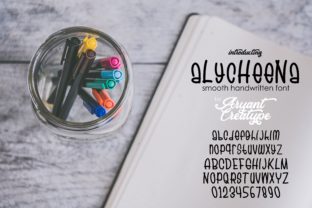
At its core, Alychenna is a single-weight, uppercase-and-lowercase Latin-script font with standard punctuation and numerals. Its design language leans into subtle irregularities: varying stroke widths, gentle baseline shifts, and soft entry/exit terminals that suggest movement without sacrificing clarity. Unlike many script fonts that rely on contextual alternates or ligatures to feel authentic, Alychenna achieves cohesion through thoughtful spacing and balanced letterfit—meaning it works well at sizes from 24px in web headers to 72pt in printed posters, without requiring manual kerning adjustments in most cases.
The “playful vibe” often associated with Alychenna isn’t forced—it emerges from proportion and pacing. Lowercase a, e, and s have open, airy counters; ascenders on b, d, and h rise with relaxed confidence; and the slight tilt in verticals gives the impression of forward momentum rather than rigidity. These aren’t arbitrary quirks—they’re calibrated decisions that support readability while preserving warmth.
Real-World Use Cases—and Where It Fits Best
Alychenna performs strongest in contexts where authenticity and approachability matter more than formality—especially when paired with a clean, neutral sans-serif for body text or supporting elements. For example:
- Small business branding: A local bakery, indie bookstore, or wellness studio might use Alychenna for a logo lockup or tagline, then switch to Inter or Open Sans for menus, service descriptions, or email newsletters. The contrast reinforces personality without compromising scannability.
- Digital content headers: Blog post titles, course module headings, or newsletter subject lines benefit from Alychenna’s visual distinctiveness—particularly on mobile, where its generous x-height and open shapes hold up better than tighter scripts.
- Educational materials for younger audiences or creative learners: Teachers designing printable worksheets or educators building online learning modules report that Alychenna feels inviting without appearing childish—unlike overly cartoonish handwriting fonts that can undermine credibility in academic or professional development settings.
- Product packaging and labels: When used sparingly—for flavor names, origin statements, or artisanal certifications—Alychenna adds tactile appeal without competing with essential regulatory text.
It’s less effective for long-form body copy, dense data tables, or interfaces requiring high functional legibility (e.g., dashboard UIs or accessibility-critical forms). Those uses fall outside its intended scope—and that’s a strength, not a limitation. Alychenna was built as a display face, and treating it as such yields better results.
Usability, Compatibility, and Workflow Integration
Alychenna ships in modern OpenType (.otf) and variable-web-friendly WOFF2 formats, supporting standard Unicode Latin-1 coverage. It includes basic OpenType features—such as stylistic sets for alternate ‘g’ and ‘y’ forms—but doesn’t depend on advanced typographic engines to function. That means it renders predictably across platforms: Figma, Adobe Creative Cloud, Google Fonts (if self-hosted), and even basic CMS editors like WordPress blocks or Squarespace text modules.
One practical note: because Alychenna’s lowercase letters connect only minimally (and never obligatorily), it avoids the common pitfall of script fonts that break awkwardly mid-word in responsive layouts. Line breaks behave predictably, and hyphenation—while not enabled by default—can be applied safely without distorting the letterforms.
For freelancers managing multiple client projects, Alychenna’s licensing is straightforward: one-time purchase with broad usage rights, including commercial print, web, and app embedding. No subscription model or per-seat fees complicate budgeting or asset handoff.
Who Benefits Most—and Who Might Look Elsewhere
Professionals who regularly balance brand voice with functional communication will find Alychenna especially useful. Think freelance designers crafting identity systems for lifestyle brands, marketers building email campaigns for boutique services, or educators developing branded course assets. Its consistency across mediums means a workshop title looks cohesive whether it appears on a Canva slide, an Instagram Story, or a printed handout.
Entrepreneurs launching a new product or service often overestimate how much personality a font alone can convey. Alychenna helps here—not by doing all the work, but by offering a reliable, human-scaled element that supports storytelling rather than overshadowing it. A founder describing their sustainable skincare line in a launch video benefits from Alychenna’s warmth in lower-third text—without needing to animate every letter or add decorative flourishes.
That said, Alychenna may not suit every project. If your audience expects precision, authority, or technical rigor—think financial reports, legal disclosures, or enterprise SaaS dashboards—a more structured typeface would align better with user expectations. Similarly, designers working extensively with non-Latin scripts should verify glyph coverage before committing, as Alychenna currently focuses on Western European languages.
Long-Term Value and Design Longevity
Typography choices often age quickly when tied too closely to current visual trends. Alychenna sidesteps this by drawing from enduring qualities: rhythm, proportion, and restraint. It doesn’t try to be “vintage,” “modern,” or “retro”—it simply reads as human. That neutrality gives it staying power. Projects using Alychenna today are unlikely to feel dated in two or three years, provided it’s applied with intention and paired thoughtfully.
Its file size is modest (under 100KB for WOFF2), which supports fast-loading websites without sacrificing visual impact. And because it avoids excessive decoration or extreme contrast, it scales cleanly across devices—from retina displays to low-resolution projectors—without requiring fallback stacks or complex CSS overrides.
In practice, Alychenna earns its place not as a novelty, but as a dependable tool: one that adds nuance without demanding extra effort. It won’t replace your system font stack, but it reliably fills a specific gap—where warmth, clarity, and quiet confidence intersect. Used well, it becomes part of the background texture of good design: noticeable enough to resonate, unobtrusive enough to serve.