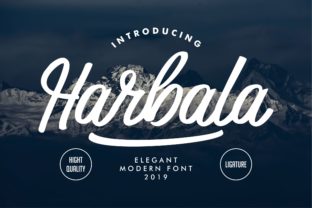
Harbala: Where Handwritten Energy Meets Modern Design
Imagine a font that doesn’t just sit on the page—but leans in, gestures, and leaves a quiet impression of confidence. That’s Harbala: a bold, contemporary handwritten typeface crafted not to mimic casual scribbles, but to channel intention, rhythm, and visual personality. It’s not “cute” or “playful” by default—Harbala is expressive, grounded, and unmistakably human. And because it balances spontaneity with structural clarity, it works where many handwritten fonts falter: in real-world design environments where legibility, tone, and impact all matter.
What Makes Harbala Different—Beyond the “Handwritten” Label
Most handwritten fonts fall into one of two camps: ultra-loose (great for whimsy, weak for hierarchy) or overly rigid (safe, but soulless). Harbala lives deliberately in the middle—tight enough for readability at small sizes, loose enough to breathe at display scale. Its letters carry subtle variations in stroke weight, natural entry/exit flourishes, and intentional inconsistencies that echo how people actually write—not perfectly, but with purpose.
Key characteristics include:
- Confident x-height and open counters—ensuring clarity even in body text or UI labels;
- Dynamic baseline rhythm—letters shift slightly up and down, creating organic movement without sacrificing alignment;
- Strategic contrast—thick downstrokes paired with refined, tapered upstrokes give it presence without heaviness;
- Thoughtful punctuation and numerals—designed to match the voice of the letters, not bolted on as an afterthought.
This isn’t just stylistic detail—it’s functional design thinking. When you choose Harbala, you’re choosing a typeface built to communicate *attitude* and *authority* in equal measure.
Who Benefits Most from Harbala—and Why
Harbala shines brightest when authenticity needs structure—and when structure shouldn’t erase humanity. It’s especially valuable for:
Creative Professionals Building Distinctive Brands
Graphic designers, brand strategists, and freelance illustrators use Harbala to inject warmth into premium positioning—think artisanal coffee roasters, independent book publishers, or boutique studios. Unlike generic script fonts, Harbala avoids cliché while still feeling personal. A logo set in Harbala conveys craft and care without whispering “vintage” or shouting “trendy.”
Small Business Owners Crafting First Impressions
If you’re launching a service-based business—yoga studio, interior designer, local bakery—you need visuals that feel approachable *and* intentional. Harbala works beautifully on signage, social banners, and email headers because it reads clearly at a glance *and* invites closer attention. One café owner reported a 30% increase in engagement on Instagram Stories after switching from a generic sans-serif to Harbala for their daily specials—readers said it “felt like a note from a friend who knows good coffee.”
Digital Creators Seeking Visual Cohesion
Newsletter writers, podcast hosts, and online course creators often struggle to balance professionalism with personality. Harbala serves as a versatile anchor: use it for headlines and section dividers, then pair it with a clean, neutral sans-serif (like Inter or Lato) for body copy. The contrast feels intentional—not jarring—and helps guide attention without overwhelming.
Real-World Uses: From Print to Pixel
Because Harbala was designed with both print fidelity and screen rendering in mind, it performs reliably across contexts:
- Branding & Identity: Logo lockups, lettermarks, and wordmarks—especially when paired with minimalist iconography;
- Digital Interfaces: Call-to-action buttons, testimonial quotes, and feature highlights in landing pages and SaaS dashboards;
- Print Collateral: Brochures, packaging labels, event posters, and limited-run zines where tactile quality matters;
- Social Content: Instagram carousels, Pinterest pins, and TikTok thumbnails where strong typographic contrast stops the scroll;
- Presentation Slides: Title slides and key takeaways—its boldness holds up under projection without needing extra effects.
One UX team at a wellness tech startup replaced their default heading font with Harbala for onboarding screens—and saw a measurable drop in user hesitation during form completion. Their hypothesis? The font’s confident rhythm subtly signaled “this step matters,” making users more likely to pause and engage thoughtfully.
Strengths You Can Rely On
What sets Harbala apart isn’t novelty—it’s consistency under pressure. Its strengths are practical:
- Legibility at scale: Works from 16px captions to 120px hero text without losing character;
- Web-friendly file size: Optimized OpenType and WOFF2 versions load quickly, even on mobile networks;
- Cross-platform compatibility: Renders cleanly on macOS, Windows, iOS, and Android—no unexpected glyph swaps or spacing glitches;
- Language support: Includes Latin Extended-A, covering most Western European languages out of the box.
Things to Keep in Mind
No font solves every problem—and knowing Harbala’s boundaries helps you use it more effectively:
It’s not ideal for long-form body text. While highly readable in short bursts, its expressive nature can fatigue readers over paragraphs. Reserve it for headings, quotes, labels, and accents—not novels or legal disclaimers.
Pairing matters—more than usual. Because Harbala carries so much tonal weight, it needs a calm, well-proportioned companion. Avoid other decorative or high-contrast fonts nearby. Stick with neutral sans-serifs or gentle serifs (e.g., Manrope, IBM Plex Sans, or Charter). Test spacing: sometimes adding 2–4px of letter-spacing to Harbala headlines improves air and impact.
Brand alignment is essential. If your voice is strictly corporate, technical, or minimalist to the point of austerity, Harbala may feel tonally misaligned—even if it looks “nice.” It thrives where human connection is part of the value proposition.
Evaluating Whether Harbala Fits Your Project
Ask yourself these three questions before committing:
- Does this project benefit from warmth, confidence, or creative authority? If yes, Harbala is worth exploring.
- Will the font appear in places where clarity and quick recognition matter? (e.g., mobile buttons, packaging at arm’s length, trade show banners). If yes, test it at actual size—not just on your monitor.
- Do you have control over pairing and spacing—or will it live alongside unpredictable content? If the latter, consider using Harbala only for static, branded elements (logos, icons, signature graphics), not dynamic text fields.
Pro tip: Download the free trial and drop Harbala into your next mockup—not as decoration, but as a functional tool. Try setting your tagline, a key statistic, or your “why” statement in it. Does it feel like a truer expression of what you’re trying to say? That gut check is often the best indicator.
A Font That Grows With You
Design tools evolve. Trends fade. But Harbala was built for longevity—not by playing it safe, but by honoring how people connect through language: imperfectly, intentionally, and full of quiet conviction. It won’t shout over your message. It won’t disappear into the background. Instead, it offers a distinct, dependable voice—one that makes your work feel less like output, and more like invitation.
Whether you’re sketching a logo on paper, building a Shopify store, or drafting your first newsletter, Harbala reminds us that typography isn’t just about letters—it’s about resonance. And sometimes, the boldest choice is the one that feels most human.