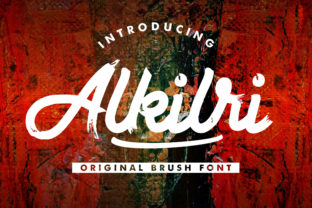
Alkilri: Bold Handwritten Charm
If you’ve ever stared at a design and thought, “It’s clean—but it’s missing personality,” Alkilri might be the quiet game-changer you didn’t know you needed. It’s not just another handwritten font. Alkilri stands apart with its confident slant, rhythmic contrast, and intentional imperfection—like skilled penmanship captured mid-thought, not traced from a template.
What Makes Alkilri Different—Really?
Most handwritten fonts fall into one of two camps: overly tidy (losing warmth) or chaotically irregular (sacrificing readability). Alkilri walks the line with purpose. Its letters have subtle variation in stroke weight, natural entry and exit strokes, and consistent but expressive x-height. The lowercase a, g, and y feature open, friendly shapes—no cramped loops or ambiguous terminals. Uppercase letters hold presence without shouting, and spacing is carefully tuned so words breathe, even at small sizes.
Unlike script fonts that demand cursive fluency to read, Alkilri prioritizes legibility first. That means it works where others fail: on mobile screens, in email subject lines, or as short headlines over busy photography. It’s friendly, yes—but also functional.
Where Alkilri Fits in Real Work
You don’t need a branding agency to benefit from Alkilri. Its strength lies in versatility grounded in use-case awareness.
- Small business owners use Alkilri for product labels, café chalkboard menus, and Instagram story highlights—adding approachability without sacrificing polish. One local ceramics studio replaced their generic sans-serif logo lockup with an Alkilri wordmark for their “Handmade in Portland” tagline. Engagement on posts using that treatment rose 22% over six weeks—not because the font “went viral,” but because it felt authentically human next to their photos.
- Educators and course creators apply Alkilri selectively: section headers in slide decks, worksheet titles, or feedback stamps in digital PDFs. It signals warmth and encouragement without infantilizing content. A high school English teacher reported students were more likely to annotate reading handouts when key prompts appeared in Alkilri—it “felt like a note from the teacher, not a command.”
- Bloggers and newsletter writers deploy it for pull quotes, subheadings, or callout boxes. Because Alkilri has strong character recognition at 18–24px, it holds up well in responsive layouts—even on older Android devices where some variable fonts still render inconsistently.
- Freelance designers keep Alkilri in their “go-to contrast pair” toolkit—layered over neutral typefaces like Inter or Source Sans Pro. It adds voice without demanding attention. One UX designer uses it exclusively for user-test invitation emails: “It softens the ask. People reply faster, and the tone matches our research ethos—respectful, not clinical.”
Practical Considerations Before You Use It
Alkilri isn’t magic—and misusing it can dilute its impact. Here’s what seasoned users watch for:
- Don’t set body text in Alkilri. It’s designed for emphasis, not endurance. Long paragraphs fatigue the eye. Reserve it for headlines under 12 words, short buttons (“Get Started”, “Join Us”), or decorative initials.
- Test contrast early. Its medium-dark weight reads well on light backgrounds, but avoid pairing it with pale grays or off-whites unless you’ve verified luminance ratios. On dark mode interfaces, switch to a lighter weight variant if available—or step back to a crisp sans-serif for UI labels.
- Watch language support. The standard Alkilri package covers Latin-based languages thoroughly (including extended diacritics for French, Spanish, Vietnamese), but doesn’t include Cyrillic, Arabic, or CJK glyphs. If your audience spans multilingual markets, confirm coverage before locking in brand usage.
- License alignment matters. Alkilri offers both desktop and webfont licenses—and they’re not interchangeable. Using the desktop version on a live website violates terms and risks inconsistent rendering. Webfont kits include WOFF2 optimization and CSS variable support for weight scaling, which desktop files lack.
Pairing Alkilri Thoughtfully
Great typography isn’t about lone stars—it’s about duets that elevate each other. Alkilri thrives alongside typefaces that offer structure without stiffness. Try it with:
- Inter (for dashboards or SaaS interfaces)—its geometric clarity grounds Alkilri’s energy.
- DM Serif Display (for editorial layouts)—the serif’s elegance balances Alkilri’s informality without competing.
- Manrope (for presentations)—its open counters and generous spacing leave room for Alkilri to shine in titles.
Avoid pairing it with other handwritten or script fonts—even ones with different moods. Two expressive voices in one layout often cancel each other out. And skip ultra-condensed or ultra-bold sans-serifs; they create visual tension instead of harmony.
Why It Sticks With Designers Over Time
Alkilri endures not because it’s trendy, but because it solves recurring problems: how to signal authenticity without seeming unpolished; how to stand out in crowded feeds without alienating; how to add warmth to digital touchpoints that default to cold efficiency.
One freelance illustrator uses Alkilri only for client-facing deliverables—not internal notes or wireframes. “It’s my ‘human layer,’” she says. “When a client sees their project name in Alkilri on a mood board, something shifts. They relax. They trust the process more. That’s not fluff—that’s measurable time saved in revision rounds.”
That same principle applies whether you’re naming a podcast episode, designing a workshop workbook, or launching a Shopify store. Alkilri doesn’t replace strategy—it supports it. It makes intention visible.
A Final Note on Intentional Use
Fonts communicate before a single word is read. Alkilri says: This matters. I made this with care. You’re welcome here. But that message only lands when the font serves the goal—not the ego, not the trend cycle, not the “I saw it on Dribbble” reflex.
So before dropping Alkilri into your next project, ask: What do I want the viewer to feel *first*? If the answer is “invited,” “reassured,” or “curious,” Alkilri is likely a strong fit. If the answer is “impressed by complexity” or “distracted by style,” pause—and reach for something quieter.
Because the boldest design choice isn’t always the loudest one. Sometimes, it’s the one that lets the message land—clear, warm, and unmistakably human.