Discover Lovely Creature: A Bold Handwritten Font That Breaks All the Rules
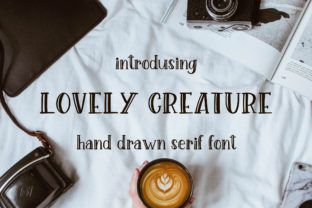
Imagine a font that doesn’t just sit quietly on the page—but winks, tilts its head, and dances across your screen with unapologetic charm. That’s Lovely Creature: a bold, expressive handwritten typeface that swaps polish for personality and perfection for playfulness. More than just another decorative script, Lovely Creature is a deliberate celebration of imperfection—designed to feel human, spontaneous, and vibrantly alive.
What Exactly Is Lovely Creature?
At its core, Lovely Creature is a hand-drawn display font created by independent type designer Nikola Djordjevic. Released in 2019, it quickly gained traction among designers, educators, and small business owners seeking typography with soul—not sterility. Unlike traditional serif or sans-serif fonts built for legibility at small sizes, Lovely Creature thrives in larger applications: logos, posters, social media graphics, book covers, and packaging.
Its defining traits include:
- High-contrast strokes—thick downstrokes paired with hairline upstrokes for dramatic visual rhythm;
- Irregular baseline and x-height—letters don’t align neatly, creating a charming, off-kilter energy;
- Unexpected ligatures and alternate characters, like a looping “&” or a winking “Q”, adding layers of surprise;
- A “kooky twist” in every glyph—notice how the lowercase “g” grins sideways or the “y” curls like a sleeping cat.
This isn’t accidental quirkiness—it’s intentional design language. Each irregularity invites the viewer to pause, smile, and connect emotionally with the text.
Why Does a “Weird and Kooky” Font Matter Today?
In an age saturated with algorithmically optimized UIs, AI-generated content, and ultra-minimalist branding, authenticity has become a rare commodity. Lovely Creature stands out precisely because it resists automation. Its imperfections signal humanity—a hand guiding a pen, not a machine rendering pixels. That resonance is why it’s embraced across industries where emotional connection drives engagement:
- Educational materials—teachers use it in classroom posters and digital worksheets to make learning feel warm and inviting, especially for younger learners who respond to expressive visuals;
- Small business branding—bakeries, indie bookshops, and handmade goods sellers choose Lovely Creature for signage and Instagram stories to convey craft, care, and individuality;
- Creative campaigns—nonprofits promoting mental health awareness or environmental causes deploy it to soften serious messaging with empathy and approachability;
- Digital illustration and motion graphics—animators layer Lovely Creature over hand-drawn scenes to unify tone and amplify narrative warmth.
Crucially, Lovely Creature isn’t “just for fun.” It fulfills real communication goals: building trust through relatability, increasing memorability through distinctiveness, and lowering psychological barriers between brand and audience.
Debunking Common Misconceptions
Before diving into usage, let’s clear up a few assumptions:
- “It’s only for kids’ stuff.” — False. While it works beautifully in playful contexts, its bold weight and confident rhythm translate powerfully in adult-oriented design—think boutique wellness studios or avant-garde fashion lookbooks.
- “You can’t read it at small sizes.” — True, but that’s by design. Lovely Creature isn’t meant for body text or legal disclaimers. It’s a display font, like a spotlight actor—not the supporting cast. Pair it with a clean, highly legible companion font (e.g., Inter, Lora, or even Roboto) for balanced hierarchy.
- “Using it makes my design look unprofessional.” — Only if misapplied. Professionalism isn’t defined by rigidity—it’s defined by intentionality. A well-considered use of Lovely Creature signals confidence, creativity, and audience insight.
How to Use Lovely Creature Effectively (Without Overdoing It)
Like any strong voice, Lovely Creature shines brightest when given space to speak—and when supported by thoughtful context. Here’s how to harness its energy wisely:
1. Prioritize Hierarchy and Contrast
Use Lovely Creature exclusively for headlines, quotes, or key calls-to-action. Let your secondary font handle paragraphs, captions, and navigation. This contrast doesn’t dilute impact—it amplifies it. For example: a wedding invitation might set the couple’s names in Lovely Creature, while date, time, and location appear in a refined serif like Playfair Display.
2. Respect Its Natural Rhythm
Don’t force tight letter-spacing (tracking) or aggressive kerning. Lovely Creature breathes best with generous spacing—especially in all-caps settings. Try increasing tracking by +50–100 units in design software to preserve its bouncy, organic flow.
3. Leverage Its Alternates
The font includes stylistic alternates (accessible via OpenType features in apps like Adobe Illustrator or Figma). Swap in the smiling “S”, the spiraling “R”, or the double-looped “8” to add subtle storytelling nuance—ideal for limited-edition packaging or seasonal campaigns.
4. Test Across Contexts
Preview how Lovely Creature renders on mobile screens, email clients, and print. Some platforms don’t support OpenType features, so always export fallback versions (e.g., SVG for web headers or outlined vectors for print). Never embed it as live text in non-design environments without verifying compatibility.
Where Lovely Creature Fits in the Bigger Typography Picture
Typography is never neutral—it’s cultural code. Lovely Creature belongs to a growing movement of expressive typefaces that reject the neutrality of Helvetica or the austerity of system fonts. It joins peers like Bungee Shade, Comic Neue, and Amatic SC—fonts that prioritize voice over versatility.
Yet Lovely Creature stands apart through its balance: it’s bold enough to command attention, but soft enough to feel inclusive; kooky enough to spark joy, but grounded enough to retain clarity. In educational tech, for instance, it’s used in early literacy apps to turn phonics practice into a joyful ritual. In UX writing, product teams occasionally use it sparingly in empty-state illustrations (“Oops! Something went kooky…”) to defuse user frustration with gentle humor.
This reflects a broader shift: from fonts as functional tools to fonts as emotional interfaces. As AI generates more content—and more sameness—human-centered design choices like Lovely Creature become strategic differentiators.
Final Thought: Typography With Heart
Choosing Lovely Creature isn’t just about aesthetics. It’s a quiet declaration: I value feeling as much as function. I believe clarity can coexist with character. I want my message to be remembered—not just read.
Whether you’re a teacher designing a classroom welcome banner, a founder launching a sustainable skincare line, or a student crafting a passion project presentation, Lovely Creature offers permission—to be imperfect, expressive, and unforgettably you. And in a world that often rewards speed over sincerity, that kind of permission is rare, valuable, and deeply lovely.
So go ahead: download it, experiment fearlessly, and let your words wear their heart on their sleeve. After all, the most memorable messages aren’t always the loudest—they’re the ones that make us smile, pause, and say, “Oh—I feel seen.”