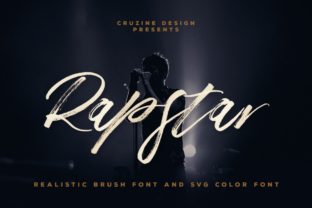
Rapstar: A Bold Handwritten Font with Swashes
Rapstar isn’t just another script font—it’s a confident, expressive typeface built for movement. With energetic letterforms and thoughtfully designed swashes that flow like ink pulled by instinct, it brings rhythm and personality to headlines, logos, quotes, and short-form design. It’s not meant for body text or dense paragraphs. Instead, Rapstar shines where voice matters most: a boutique’s storefront sign, an educator’s classroom poster, a freelancer’s portfolio banner, or a small business owner’s Instagram story.
Why Rapstar Feels Different
Most handwritten fonts fall into one of two camps: overly casual (like quick pen sketches) or rigidly stylized (like calligraphic formal scripts). Rapstar sits confidently between them—charming but intentional, spontaneous but controlled. Its swashes aren’t decorative afterthoughts; they’re integrated, functional extensions of the letters themselves. That means you can activate them selectively—swap in a flourished “R” at the start of a word, or let the “y” or “g” trail with graceful curves—without breaking visual harmony.
It’s also carefully spaced and kerned. That may sound technical, but it matters: Rapstar looks balanced whether you’re typing “Rapstar” or “Joy,” “Create,” or “You’re Invited.” No awkward gaps. No crowded collisions. Just natural rhythm, right out of the box.
For Beginners & Hobbyists
If you’ve ever opened Canva or tried customizing a birthday card in Google Slides and felt limited by generic fonts, Rapstar offers instant uplift—with zero design training required. You don’t need to know OpenType features to use it well. Type your phrase, pick Rapstar from your font menu, and try pairing it with a clean sans-serif (like Inter or Montserrat) underneath for contrast. That’s often enough to make a flyer, social post, or printable quote feel intentionally crafted—not templated.
Beginners also appreciate how Rapstar avoids visual fatigue. Unlike some ultra-thin or overly busy scripts, its bold weight gives clarity even at smaller sizes (think 24–36pt for headings), and its swashes are subtle enough not to distract when used sparingly.
For Educators & Content Creators
In classrooms or online courses, tone shapes trust. A warm, human-sounding font like Rapstar helps break down formality without sacrificing professionalism. Imagine using it for slide titles (“Why Fractions Matter”), handout headers (“Your Weekly Challenge”), or student-facing feedback banners (“You’ve Got This!”). It signals approachability—especially helpful for educators supporting neurodiverse learners or building inclusive digital spaces.
Bloggers and newsletter writers sometimes use Rapstar for pull quotes or section dividers—not as body text, but as punctuation in layout. One well-placed swash-heavy word can act like a visual breath between ideas, guiding attention without shouting.
For Freelancers & Small Business Owners
When your brand voice leans creative, friendly, or artisanal—think handmade goods, wellness coaching, indie publishing, or local cafés—Rapstar supports authenticity. It doesn’t scream “corporate,” nor does it fade into background noise. Used in a logo lockup (with careful spacing and testing across sizes), it communicates care and craft.
Small business owners evaluating fonts often weigh practicality alongside aesthetics. Rapstar delivers both: it’s available in standard formats (OTF, TTF, WOFF), works reliably in Figma, Adobe apps, and web builders, and includes basic OpenType features—so if you later want to explore alternate characters or ligatures, the tools are there. No extra plugins or subscriptions needed.
For Designers & Marketers
Professionals notice what others don’t: Rapstar’s consistency across weights and styles (though currently offered as a single-weight family, its design allows for natural expansion), its hinting for screen readability, and how its x-height balances legibility with flair. It’s not “trendy”—it’s timeless-adjacent. That makes it safer for long-term brand assets, where fonts must age gracefully across platforms and devices.
Marketers running A/B tests on email subject lines or landing page headers sometimes find Rapstar increases engagement—not because it’s flashy, but because it feels *human*. In a feed full of algorithm-optimized sans-serifs, a well-set Rapstar headline stands out with warmth, not noise.
What to Consider Before Using Rapstar
Rapstar excels in specific contexts—and knowing those boundaries helps you use it well:
- Use it for emphasis, not exposition. Reserve it for headlines, logos, quotes, invitations, and short labels—not paragraphs, forms, or data tables.
- Test contrast and size. Pair it with highly legible fonts for supporting text. Avoid stacking multiple decorative fonts—it dilutes impact.
- Check licensing early. Rapstar is licensed for personal and commercial use, including digital products and client work—but always verify the license terms match your intended use (e.g., embedding in apps or SaaS platforms may require extended rights).
- Swashes are optional—not mandatory. Start simple. Enable them only where they enhance meaning or flow, not just because they exist.
Real Moments Where Rapstar Fits Naturally
A yoga instructor adds Rapstar to her monthly newsletter header—“Breathe Deeply”—paired with soft neutral colors and ample whitespace. It conveys calm intention, not chaos.
A freelance illustrator uses Rapstar for her website’s “Work” section title, then switches to a crisp monospace font for project descriptions. The contrast highlights her range: expressive + precise.
A high school art teacher prints Rapstar-based vocabulary cards (“Texture,” “Balance,” “Rhythm”) to hang around her studio. Students recognize the words instantly—and associate them with creative energy.
A food blogger chooses Rapstar for recipe titles (“Golden Turmeric Latte,” “Smoky Roasted Carrots”) in Instagram carousels. The font’s warmth mirrors the comfort-food theme, while staying readable on mobile screens.
Does Rapstar Match Your Needs?
Ask yourself:
- Are you designing something where personality and approachability matter more than neutrality?
- Do you need a font that works quickly—without deep technical setup—but still feels intentional?
- Is your project short-form, visual-first, and human-centered?
- Do you value flexibility (swashes you can turn on/off) over complexity (dozens of stylistic sets)?
If yes, Rapstar likely fits. If you’re building a financial dashboard, legal document template, or multilingual interface requiring extensive character support, another font may serve you better.
Ultimately, Rapstar isn’t about being the loudest option—it’s about being the right kind of bold. The kind that invites attention, not demands it. The kind that feels like a thoughtful choice, not a default. And in a world full of interchangeable visuals, that kind of quiet confidence is rare—and useful.