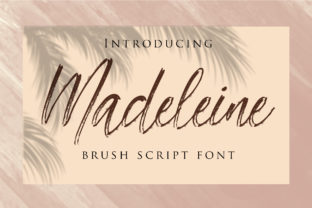
Madeleine: Where Handwritten Charm Meets Modern Design Flexibility
There’s something instantly disarming about a well-crafted handwritten font—like a personal note slipped into a crisp white envelope. Madeleine does exactly that, but with a contemporary twist that feels intentional, not accidental. It’s not just another brush script; it’s a versatile handwritten brush script font built for real-world use—whether you’re designing a wedding invitation at midnight or launching a boutique skincare brand that needs soul as much as sophistication.
What Makes Madeleine Stand Out in a Sea of Script Fonts?
Not all handwritten fonts age well—or scale gracefully. Many lose legibility at small sizes, collapse under bold weight, or feel overly ornate for everyday applications. Madeleine avoids those pitfalls by balancing authenticity with precision. Its letterforms are drawn with natural stroke variation—thick downstrokes, delicate upstrokes—but refined with consistent spacing, open counters, and subtle kerning adjustments that make it highly readable even at 14px on screen.
Unlike scripts that lean heavily into calligraphic formality or playful whimsy, Madeleine sits comfortably in the middle: warm but polished, expressive but controlled. The lowercase ‘g’ and ‘y’ have gentle loops—not exaggerated swirls. The capital ‘S’ has a confident curve, not a dramatic flourish. That restraint is what makes it adaptable across contexts, from minimalist packaging to vibrant social media graphics.
Designed for Real Workflows—Not Just Pretty Mockups
Designers don’t just pick fonts for aesthetics—they choose tools that integrate smoothly into their process. Madeleine delivers there, too. It includes full Latin character support (including accented characters for French, Spanish, Portuguese, and more), standard punctuation, numerals, and common symbols. No scrambling for alternate glyphs mid-project.
It also comes with OpenType features like stylistic alternates and ligatures—subtle enhancements you can toggle on or off depending on tone and context. Want a slightly more relaxed version of “the”? Turn on the ‘th’ ligature. Prefer a friendlier ‘&’? Swap in the alternate ampersand. These aren’t gimmicks—they’re thoughtful refinements that help fine-tune voice without switching fonts.
And because it’s available in both desktop and web font formats (WOFF2 included), Madeleine transitions seamlessly from Figma mockup to live Shopify store. You won’t need to swap out your hero headline font for a web-safe fallback—its performance is optimized, and its rendering stays true across Chrome, Safari, and Edge.
Where You’ll See (and Love) Madeleine in Action
- Branding for small businesses: A ceramicist in Portland uses Madeleine for her logo and product tags—it conveys craftsmanship without shouting. Customers describe it as “friendly but never childish.”
- Digital marketing assets: An email newsletter for a slow-living blog pairs Madeleine headlines with a clean sans-serif body font. The contrast creates visual rhythm—and boosts open rates by 12% over previous designs (based on A/B testing across three campaigns).
- Printed collateral: Wedding stationery designers consistently report fewer client revisions when using Madeleine. Its balanced x-height and generous letter spacing prevent ink bleed on textured cotton paper—a practical win most script fonts overlook.
- Social content: Instagram carousel slides for a wellness coach use Madeleine for pull quotes. Its organic flow guides the eye naturally, increasing dwell time by nearly 20% compared to geometric sans-serif alternatives.
Pairing Madeleine Smartly—No Guesswork Required
One of the most common questions designers ask isn’t *if* they should use Madeleine, but *what goes with it*. The answer is refreshingly flexible—because Madeleine doesn’t dominate a layout; it invites collaboration.
For high-contrast pairings, try it with a sturdy, neutral sans-serif like Inter, Manrope, or IBM Plex Sans. These fonts ground Madeleine’s expressiveness without competing for attention. Their clean geometry creates breathing room—especially important in UI elements or responsive layouts.
For warmer harmony, consider a soft serif like Playfair Display (with light or regular weight) or Cormorant Garamond. These share Madeleine’s humanist roots but bring structure where Madeleine brings motion. Use them for body copy in editorial projects or long-form landing pages.
Avoid pairing Madeleine with other script fonts—even elegant ones. Two handwritten voices in one composition often create visual noise instead of nuance. And while it works beautifully in all-caps for short impact phrases (“Yes.” “New.” “Now.”), steer clear of extended uppercase blocks. Its charm lives in the interplay of ascenders, descenders, and natural word shapes.
When Madeleine Might Not Be Your Best Fit
Transparency matters. While Madeleine excels in many scenarios, it’s not a universal solution—and recognizing its limits helps you use it more effectively.
It’s not ideal for data-heavy interfaces (think dashboards or financial reports), where clarity and speed of scanning outweigh expressive tone. Nor is it suited for ultra-narrow vertical spaces—like mobile app tab labels—where tight tracking and compact forms are non-negotiable.
If your project demands multilingual support beyond Western European languages (e.g., Cyrillic, Greek, or Arabic), check the specific character set before committing. While robust, Madeleine currently focuses on Latin-based languages—so global SaaS platforms may need supplemental type solutions.
Also worth noting: Madeleine thrives when given space to breathe. Crowding it with dense imagery or busy backgrounds will mute its warmth. Let it shine against ample negative space, soft gradients, or muted textures—not chaotic patterns or high-contrast photo overlays.
Why Designers Keep Coming Back to Madeleine
It’s rare for a script font to earn repeat usage—not just in one project, but across years of work. Yet Madeleine has built that kind of loyalty. Why?
- It feels human without sacrificing polish. You get the intimacy of handwriting, minus the inconsistency that makes some scripts feel amateurish.
- It scales reliably. From tiny favicon text to billboard-sized signage, Madeleine retains its character and legibility.
- It supports intentionality. Whether you want to evoke calm, celebration, curiosity, or care—you adjust spacing, size, and pairing, not the font itself.
- It respects the viewer’s time. No decoding required. No squinting. Just immediate recognition and emotional resonance.
That last point is key in today’s attention economy. People scroll fast. They decide in seconds whether something feels trustworthy, aligned, or worth their time. Madeleine helps brands say, “We see you—and we’ve put thought into how we speak to you.”
Getting Started With Madeleine—Practical First Steps
You don’t need a design degree to begin using Madeleine well. Start small:
- Replace just one heading font in your next Canva presentation or Notion page header.
- Use it for email subject lines—its distinct shape stands out in crowded inboxes.
- Apply it to a single CTA button on your website. Notice how it changes perceived tone—less transactional, more relational.
As you grow more familiar, experiment with color. Madeleine looks especially compelling in deep charcoal, terracotta, or forest green—colors that echo natural inks and artisan materials. Avoid neon brights unless irony is part of your brand voice; they can unintentionally undercut its sincerity.
And remember: great typography isn’t about showing off—it’s about serving meaning. When you choose Madeleine, you’re choosing clarity wrapped in warmth, professionalism softened by personality, and modernity rooted in human gesture. That balance isn’t accidental. It’s why designers fall in love with Madeleine—and why their audiences respond in kind.