Rose Malow Font: A Light, Authentic Handwritten Typeface for Modern Design
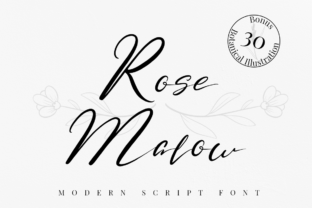
Typography is more than just letters on a screen or page—it’s emotion, voice, and intention made visible. Among the growing collection of expressive handwritten fonts, Rose Malow stands out for its delicate charm and effortless authenticity. Designed with a gentle hand and refined precision, Rose Malow is a beautiful, light handwritten font that brings warmth, personality, and subtle sophistication to any visual project.
What Is Rose Malow—and Why Does It Feel So Effortlessly Light?
Rose Malow is a modern script typeface crafted to mimic natural handwriting—yet with consistent spacing, balanced proportions, and intentional elegance. Its defining characteristic is its incredibly light weight: thin strokes, airy letterforms, and generous negative space create a sense of airiness and calm. Unlike bolder scripts that command attention through contrast and drama, Rose Malow invites closeness—like a quiet note passed between friends or a personal signature on a handmade card.
This lightness isn’t accidental. It’s the result of deliberate design choices: minimal stroke variation, soft entry and exit terminals, and open counters (the enclosed spaces inside letters like “a,” “e,” or “o”). These features reduce visual density, making text feel breathable—even at larger sizes. That’s why designers often describe Rose Malow as “cool” and “authentic”: it avoids over-stylization while still feeling intentional and polished.
The Purpose Behind the Simplicity
At its core, Rose Malow serves a clear purpose: to humanize digital and printed communication. In an age dominated by sleek sans-serifs and algorithmically optimized UIs, handwritten fonts like Rose Malow act as visual anchors for empathy, individuality, and craft. They signal care—not just in what’s being said, but in how it’s presented.
It’s commonly used in contexts where warmth and sincerity matter most:
- Wedding invitations and stationery—where elegance meets intimacy
- Branding for wellness, lifestyle, or boutique businesses—think yoga studios, artisanal bakeries, or sustainable fashion labels
- Social media graphics and Instagram stories—adding organic texture to otherwise uniform feeds
- Editorial accents in magazines or blogs—highlighting quotes, pull-outs, or section headers
- Educational materials for younger learners—its flowing, legible forms support early reading confidence
Importantly, Rose Malow is not intended for body text or long-form reading. Its light weight makes it less legible at small sizes or on low-resolution screens—a practical limitation, not a flaw. Understanding this helps designers use it intentionally, rather than defaulting to trend-driven choices.
How Rose Malow Fits Into Today’s Creative Landscape
In creative work today, authenticity is no longer optional—it’s expected. Consumers, students, and collaborators alike respond to visuals that feel genuine, not generic. Rose Malow answers that need without veering into nostalgia or kitsch. It doesn’t imitate vintage lettering or calligraphy tools; instead, it reflects contemporary handwriting—slightly imperfect, gracefully uneven, quietly confident.
For entrepreneurs and small business owners, choosing Rose Malow can be a strategic branding decision. A café logo set in Rose Malow communicates approachability and craftsmanship far more effectively than a standard serif or sans-serif could. Similarly, educators integrating Rose Malow into classroom posters or digital learning modules subtly reinforce values like creativity, expression, and personal voice.
Technologically, Rose Malow performs well across platforms. It’s available in OpenType format with standard ligatures and alternate characters—supporting nuanced typographic control in design software like Adobe Illustrator, Figma, or Canva. Many versions also include multilingual character sets, extending its usefulness for global or inclusive projects.
Common Misconceptions About Light Handwritten Fonts
Because of its delicate appearance, Rose Malow is sometimes misunderstood. Here are three frequent assumptions—and why they don’t tell the full story:
- “Light fonts are always fragile or hard to read.” While true at very small sizes or poor contrast, Rose Malow shines in medium-to-large applications—especially with thoughtful color pairing (e.g., charcoal gray on ivory paper or soft sage on cream). Legibility depends on context, not just weight.
- “Handwritten fonts lack professionalism.” Not at all. When paired thoughtfully—with clean supporting typefaces, ample whitespace, and consistent hierarchy—Rose Malow conveys refinement and intentionality. Think of it as the handwritten signature on a beautifully typeset contract.
- “It’s only for ‘feminine’ or ‘cute’ aesthetics.” This is a limiting stereotype. Rose Malow’s neutrality and restraint make it adaptable across tones—from minimalist tech startups highlighting mission statements to architectural firms presenting client proposals with quiet confidence.
Practical Tips for Using Rose Malow Effectively
Getting the most from Rose Malow means respecting its strengths—and working within its natural boundaries. Here’s how to use it wisely:
- Pair it intentionally. Contrast is key. Pair Rose Malow with a clean, neutral sans-serif (like Inter, Lato, or Montserrat) for balance. Avoid other decorative or script fonts nearby—they’ll compete for attention.
- Use it for emphasis, not exposition. Reserve Rose Malow for headlines, logos, short quotes, or call-to-action buttons—not paragraphs or data tables.
- Adjust tracking (letter spacing) carefully. Its light nature benefits from slightly increased tracking to prevent letters from visually merging—especially in all-caps usage.
- Test readability across devices. Preview your design on mobile, tablet, and desktop. If text disappears or blurs on smaller screens, scale up or switch to a more robust fallback.
- Respect licensing. Rose Malow is typically offered under commercial licenses. Always verify usage rights—especially for client work, merchandise, or web embedding via @font-face.
Beyond Aesthetics: The Emotional Impact of Thoughtful Typography
Typography shapes perception before a single word is read. Rose Malow doesn’t shout—it leans in. That quiet presence builds trust. In education, it softens academic rigidity. In healthcare communications, it eases anxiety. In marketing, it fosters connection over conversion.
Consider this real-world example: A mental health counselor redesigned her website’s “About Me” section using Rose Malow for the opening sentence—“I believe healing begins with feeling truly seen.” Paired with warm photography and ample margins, the font transformed a clinical bio into a compassionate invitation. Clients reported feeling “immediately calmer” upon landing on the page.
That’s the power of context-aware typography: it doesn’t just deliver information—it prepares the reader to receive it.
Final Thoughts: Choosing Rose Malow Is a Choice for Humanity in Design
Rose Malow is more than a font—it’s a reminder that digital tools can serve emotional intelligence as much as efficiency. Its lightness isn’t emptiness; it’s space for reflection. Its handwritten quality isn’t casual—it’s curated care. And its growing popularity reflects a broader cultural shift: toward authenticity, slowness, and human-centered creation.
Whether you’re a designer refining a brand identity, a teacher crafting classroom resources, a startup founder building a values-driven website, or simply someone selecting a font for a heartfelt note—you’ll find Rose Malow both accessible and meaningful. It asks little of the eye but gives much to the heart.
So next time you reach for a typeface, consider what tone you want to set—not just what looks “nice.” With Rose Malow, you’re not just choosing letters. You’re choosing lightness. You’re choosing authenticity. You’re choosing connection.