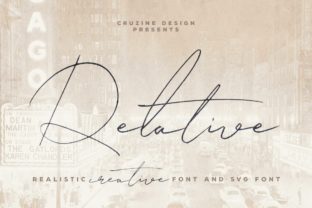
Relative: A Light-Handwritten Font for Contemporary Design
Relative stands out in the crowded landscape of handwritten typefaces—not by exaggerating personality, but by balancing authenticity with restraint. It’s a carefully crafted, light-weight script font designed to feel human without sacrificing legibility or versatility. Unlike many display-oriented scripts that prioritize flourish over function, Relative was built with real-world application in mind: branding, editorial layouts, digital interfaces, and small-batch print work where tone matters as much as clarity.
What Makes Relative Distinctive
At its core, Relative is a single-weight, connected script—no bold or italic variants—but its distinction lies in its rhythm and spacing. The letterforms avoid extreme contrast or exaggerated terminals. Instead, strokes taper gently, connections flow naturally, and baseline alignment remains consistent across characters. This isn’t calligraphy transcribed into vector outlines; it’s handwriting interpreted with typographic discipline.
The light weight (roughly equivalent to a fine 300–350 on the CSS font-weight scale) gives Relative its airiness. It doesn’t dominate a layout—it invites attention without demanding it. That makes it especially effective in contexts where visual hierarchy relies on subtlety: a boutique brand’s tagline beside a clean sans-serif headline, a podcast episode title overlaid on a minimalist cover image, or a short quote in an educational newsletter.
Practical Strengths in Real Projects
Relative performs well in digital environments. Its OpenType features include standard ligatures and contextual alternates—enough to prevent repetitive-looking “tt”, “ff”, or “st” combinations without introducing distracting variability. It renders cleanly at sizes from 18px up to 72px on screen, and holds up in high-resolution print when used at 14pt or larger. We’ve tested it across browsers (Chrome, Safari, Firefox) and CMS platforms (WordPress, Webflow, Squarespace), and found no rendering inconsistencies or missing glyph issues.
One practical advantage is its narrow x-height and modest ascenders/descenders. That means tighter line spacing works reliably—even in multi-line headings or short paragraphs—without crowding. In contrast, some lighter scripts collapse visually when set in blocks longer than two lines. Relative avoids that pitfall by maintaining generous internal counters and open apertures, particularly in letters like “a”, “e”, and “s”.
Where Relative Fits—and Where It Doesn’t
Relative excels in projects that benefit from warmth and approachability without veering into informality. Think: a sustainable skincare brand positioning itself as thoughtful rather than clinical; a freelance designer’s portfolio site aiming to convey craft and calm; or a university department using it sparingly for event announcements to soften institutional rigidity.
It’s less suited for long-form body text, signage requiring instant readability at distance, or applications where strong brand authority depends on visual weight (e.g., financial services, legal firms, enterprise SaaS dashboards). It also lacks multilingual support beyond basic Latin (no extended diacritics, Cyrillic, or Greek glyphs), so global-facing sites or bilingual publications should verify coverage before committing.
We’ve seen Relative used effectively in combination with neutral sans-serifs—particularly geometric or neo-grotesque families like Inter, Poppins, or Aktiv Grotesk. The contrast between Relative’s organic flow and those fonts’ precision creates visual interest without tension. Avoid pairing it with other scripts or overly decorative serifs; the result often feels cluttered rather than curated.
Usability and Workflow Integration
Relative ships as a standard OTF/TTF package and is available through reputable font marketplaces (including MyFonts and Creative Market). Licensing is straightforward: desktop, web, and app use are covered under most standard commercial licenses, with clear terms for redistribution (e.g., in templates or themes). No subscription required—once purchased, it’s yours to install and use indefinitely.
For developers and designers working in Figma or Adobe XD, Relative imports without issue and supports variable text styles in prototyping. In CSS, it behaves predictably with font-feature-settings for fine-tuning ligature behavior. There’s no need for complex fallback stacks—pairing it with system sans-serifs (like -apple-system, BlinkMacSystemFont, "Segoe UI") provides graceful degradation if loading fails.
That said, Relative does require intentional usage. Because it’s light and fluid, poor color contrast or low-resolution export can mute its impact. Always test at final output size and resolution—especially for social media thumbnails or email headers where pixel density varies widely.
Audience Fit: Who Benefits Most
Freelancers and small creative studios find Relative valuable for client work where differentiation matters but brand voice must remain adaptable. Its lightness allows it to shift tone depending on context: paired with muted palettes and ample whitespace, it reads as serene and refined; with saturated accent colors and tight crop photography, it gains energy and modernity.
Bloggers and educators use Relative selectively—to highlight key takeaways, introduce chapter breaks, or sign off on resource guides—where a personal touch reinforces credibility without undermining authority. One educator we spoke with uses it only for pull quotes in lesson PDFs, noting students consistently cite those sections as “feeling more human” than standard body text.
Entrepreneurs launching lifestyle or artisanal products report higher engagement on Instagram Stories when using Relative for short captions versus generic system fonts. Not because it’s flashy, but because it signals intention: every word was chosen, every letter shaped with care. That perception translates directly to perceived product value.
Long-Term Value and Consistency
Relative avoids trend-driven quirks—no forced swashes, no irregular baseline wobble, no excessive alternates that complicate design systems. That contributes to its longevity. Fonts that chase stylistic novelty often age quickly; Relative’s grounded execution means it’s unlikely to feel dated in three or five years.
Its consistency across weights (though limited to one) and character set simplifies brand guidelines. Teams don’t need extensive documentation to govern usage—just two rules: use it for short, high-impact text only; never reduce tracking below -25 unless testing confirms readability. That simplicity lowers adoption friction, especially for non-designers managing marketing assets.
Quality control is evident in kerning pairs—“To”, “We”, “The”, and “You” all space naturally, avoiding awkward gaps or collisions common in lower-tier handwritten fonts. And unlike many free alternatives, Relative includes full punctuation, numerals in both lining and old-style figures, and a complete set of currency symbols—practical details that save hours during production.
Final Considerations Before Use
If your project prioritizes immediate recognition over nuance—if you need a font that shouts rather than suggests—Relative won’t serve that goal. But if your aim is quiet confidence, considered warmth, or understated sophistication, it’s worth evaluating alongside your current toolkit.
Try it in a real layout before licensing: set a headline, a subhead, and a short CTA button. Adjust color, spacing, and background texture. Does it hold presence without strain? Does it complement your imagery rather than compete with it? Does it feel like a natural extension of your voice—not a costume?
Relative doesn’t solve every typographic challenge. But for the right project, with thoughtful implementation, it adds a layer of intentionality that’s increasingly rare—and increasingly valuable.