Omelette: A Playful Handwritten Font
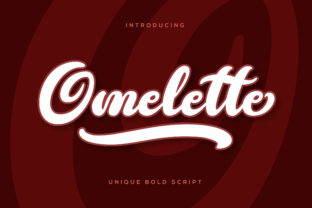
Omelette isn’t just another script font—it’s a lively, slightly uneven, warmly human typeface that feels like it was sketched with care and confidence. Its letters have gentle inconsistencies: a loop that swells just a little too much, a crossbar that tilts ever so slightly, a baseline that breathes instead of rigidly aligning. That’s the point. Omelette leans into imperfection—not as a flaw, but as character. It’s designed to feel authentic, not automated.
Why This Kind of Font Matters—Depending on Who You Are
What makes Omelette useful—or even essential—depends entirely on what you’re trying to do, who you’re speaking to, and how much time or technical comfort you have. A freelance illustrator doesn’t need the same features as a high school teacher preparing a classroom poster. A small-batch candle maker choosing packaging fonts has different priorities than a content strategist building a brand voice guide. Let’s break it down by real-world context.
For Beginners and Hobbyists
If you’ve never installed a font before—or only use what comes preloaded in Canva—you’ll appreciate how straightforward Omelette is to adopt. It works cleanly in most design tools (Figma, Adobe Express, Google Slides, even Word), and its playful energy means even simple text looks intentional. No need to adjust letter spacing manually or hunt for alternate glyphs. Just type, and it feels personal. Try it on a handmade greeting card, a weekend workshop flyer, or an Instagram Story highlight cover. You’ll notice the difference right away—not because it’s flashy, but because it feels *yours*.
For Educators and Non-Designers
Teachers, librarians, and community organizers often need to create welcoming, low-pressure visuals—think bulletin board signs, reading challenge trackers, or parent newsletter headers. Omelette helps soften formal communication without sacrificing clarity. Its lowercase “a” and “g” are open and legible; its rhythm invites attention rather than demanding it. One 4th-grade teacher told us she uses Omelette for student name tags and reward certificates because kids say it “looks like Ms. Lee wrote it herself.” That subtle warmth builds connection—and saves time on custom illustration.
For Freelancers and Small Business Owners
When your brand voice balances approachability and professionalism—say, a wellness coach, a local bakery, or a ceramic studio—Omelette offers a middle path between sterile sans-serifs and overly ornate scripts. It pairs beautifully with clean, neutral typefaces (like Inter or Lato) for contrast: use Omelette for headlines or short quotes, and a workhorse font for body text. A café owner in Portland uses it for chalkboard-style menu boards and loyalty program cards. A tarot reader uses it in digital welcome emails and printed ritual guides. In both cases, it signals care—not polish for polish’s sake, but attention paid to feeling.
For Designers and Brand Strategists
You’ll notice Omelette’s thoughtful details: consistent stroke weight, balanced x-height, and generous spacing built-in—not an afterthought. It’s not meant for long paragraphs, but it shines where personality needs to land fast: logo lockups, social media banners, product labels, or limited-edition packaging. Unlike many handwritten fonts that rely on ligatures or contextual alternates (which require OpenType-savvy tools), Omelette delivers charm with minimal setup. That makes it reliable across platforms—even when clients edit files in basic editors. One branding designer shared she keeps Omelette in her “go-to folder” for early-stage mood boards: it conveys tone faster than ten rounds of client feedback.
For Content Creators and Marketers
On crowded feeds, authenticity cuts through noise. Omelette helps written content feel less like output and more like invitation. Bloggers use it for pull quotes in newsletters. Podcasters apply it to episode title graphics. Even marketers testing email subject lines report higher open rates when Omelette appears in preview text thumbnails—likely because its organic shape stands out amid algorithmically optimized sans-serif blocks. Crucially, it avoids the “hand-drawn” cliché: no wobbly lines or forced quirkiness. It feels lived-in, not staged.
What to Consider Before You Use It
Omelette isn’t for every job—and that’s part of its strength. Ask yourself:
- Is legibility at small sizes important? Omelette works best at 16pt and up. Avoid using it for footnotes, legal disclaimers, or mobile interface labels.
- Do you need multilingual support? It includes full Latin character sets (accents, diacritics, numerals), but no Cyrillic, Greek, or extended Asian language coverage.
- Are you licensing for commercial use? Check the license terms—but most versions allow unlimited personal and commercial projects, including merchandise and client work.
- Does your team need consistency? Because it’s intentionally irregular, pairing it with ultra-rigid fonts can feel jarring. Try balancing it with warm, humanist sans-serifs—not geometric ones like Helvetica.
Real Uses, Not Hypotheticals
A homeschooling parent used Omelette to design weekly learning schedules—color-coded, laminated, and hung on the fridge. The font made routines feel flexible, not rigid.
A nonprofit launching a youth mentorship program chose Omelette for their campaign slogan (“You Belong Here”) on posters and T-shirts. Volunteers said it felt inclusive—not corporate, not childish.
A UX writer tested two versions of an onboarding tooltip: one in system font, one in Omelette. Users reported the latter felt “more encouraging,” even though the wording was identical.
None of these examples required coding, advanced typography knowledge, or expensive software. Just intention—and the right tool.
Does Omelette Fit Your Next Project?
Try this quick match test:
- You’re adding visual warmth to something that risks feeling cold or transactional.
- You want people to pause—not just scan.
- You value ease over endless customization.
- Your audience responds better to sincerity than slickness.
- You’re okay with a font that says “I made this for you”—not “I hired someone to make this perfect.”
If three or more resonate, Omelette is likely a strong fit. It won’t solve layout problems or replace thoughtful writing—but it does quietly elevate both. And sometimes, that’s exactly what a project needs: not more complexity, but more heart.