Sail Royals: A Handwritten Font That Feels Like Real Ink on Paper
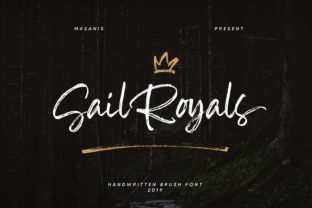
Sail Royals is a handwritten font created with a brushpen on real paper—no digital simulation, no vector smoothing, no algorithmic “handwriting” mimicry. Each glyph was drawn by hand, scanned at high resolution, and carefully digitized to preserve the texture, pressure variation, and organic imperfections of physical media. That origin shapes everything about how Sail Royals behaves in design: its rhythm, weight shifts, subtle ink bleed, and slight inconsistencies aren’t flaws—they’re signatures of authenticity.
What Makes Sail Royals Distinct from Other Handwritten Fonts?
Most handwritten fonts fall into one of two categories: stylized calligraphy (tight, formal, often with exaggerated swashes) or casual script (lightweight, bouncy, optimized for readability at small sizes). Sail Royals occupies a quieter, more grounded middle ground. Its letterforms are relaxed but intentional—neither rigid nor overly playful. The downstrokes have genuine thickness, built from real brush pressure; the upstrokes taper naturally, not uniformly. Because it was drawn on textured paper, even digital rendering retains a faint grain that subtly echoes tactile experience.
This isn’t just aesthetic nuance—it affects usability. Unlike many script fonts that rely on tight letter-spacing or ligature-heavy OpenType features to appear cohesive, Sail Royals achieves flow through natural rhythm and consistent baseline alignment. It doesn’t require extensive manual kerning for most headlines or short phrases, making it more predictable in layout than highly expressive alternatives.
Fitness for Purpose: Where Sail Royals Shines—and Where It Doesn’t
Sail Royals excels in contexts where warmth, sincerity, and human presence matter more than neutrality or scalability. Think wedding invitations, artisanal product packaging, editorial pull quotes, boutique branding, or personal stationery. Its character works especially well when paired with clean sans-serif body text—creating contrast without visual tension. A coffee roaster using Sail Royals for their “Small Batch Reserve” label gains immediate craft credibility; a tech startup using it for their app interface would likely undermine clarity and perceived professionalism.
Legibility at small sizes is its primary limitation. Below 24pt, some letters—particularly lowercase a, e, and s—begin to blur together due to minimal counter space and soft edges. It’s not designed for body copy, UI labels, or data-dense layouts. That’s not a shortcoming—it’s a constraint baked into its origin. Brushpen writing on paper wasn’t meant for 9pt captions.
Also worth noting: Sail Royals includes standard Latin characters and basic punctuation, but no extended language support (e.g., Central/Eastern European diacritics, Cyrillic, or Vietnamese tone marks). If your project requires multilingual typesetting or accessibility compliance for screen readers, you’ll need fallback fonts—and careful testing—to ensure consistency.
Comparing Approaches: Digital Simulation vs. Physical Origin
Many designers reach for “handwritten” fonts expecting personality without committing to unpredictability. What sets Sail Royals apart is its fidelity to process—not just appearance. Fonts generated via handwriting-recognition software or traced from stylus input often prioritize uniformity: consistent spacing, identical stroke endings, repeatable curves. They’re efficient, scalable, and safe—but they rarely convey the same sense of individual authorship.
In contrast, Sail Royals carries evidence of its making. You can see where the brush lifted, where ink pooled slightly at a curve’s apex, where paper texture interrupted a stroke. That authenticity resonates in projects where audience trust hinges on perceived honesty—like independent journalism, nonprofit storytelling, or creator-led brands. It signals effort, attention, and intentionality in a way algorithmically smoothed fonts simply can’t replicate.
That said, predictability has value. If your workflow demands pixel-perfect consistency across dozens of variants (e.g., dynamic web banners with auto-generated headlines), Sail Royals may introduce minor alignment hiccups or require extra QA time. A more engineered script font might integrate more seamlessly into automated systems—even if it feels less distinctive at a glance.
Practical Integration: Pairing, Sizing, and Production Notes
Sail Royals performs best as a display font—used sparingly and intentionally. For print, pair it with a robust serif (e.g., Adobe Garamond or Freight Text) or a neutral geometric sans (e.g., Aktiv Grotesk or Inter) to balance its organic energy. On screen, ensure sufficient line-height and letter-spacing: tracking between –25 and –50 units often improves readability without sacrificing cohesion.
When exporting for web use, consider variable font alternatives only if you need responsive weight control—Sail Royals is currently available as static OTF/TTF files. It lacks variable axes, so weight shifts must be handled manually via separate light/regular/bold files (if offered) or CSS opacity/layering tricks. This isn’t a technical gap—it reflects the font’s fixed physical origin. There’s no “lighter” version of a brushstroke made with less pressure on real paper.
For packaging or letterpress work, provide your printer with high-resolution outlines and confirm whether ink spread needs compensation. The slight softness of Sail Royals’ edges can interact with certain substrates or printing methods—test prints are strongly advised before final runs.
When to Choose Sail Royals—And When to Look Elsewhere
Choose Sail Royals if:
- You’re designing for an audience that values craftsmanship, intimacy, or narrative voice over speed or scalability;
- Your use case centers on short-form, high-impact text—logos, headlines, quotes, signage—not long-form reading;
- You want typography that reinforces brand qualities like approachability, care, or independence;
- You have the time and resources to test, adjust, and refine layout—rather than relying on plug-and-play compatibility.
Consider other options if:
- Your project requires multilingual support beyond basic English;
- You need reliable legibility below 18pt in digital interfaces or dense print layouts;
- You’re working under tight deadlines with minimal room for typographic iteration;
- Your brand voice leans toward precision, authority, or futurism—qualities better served by structured sans-serifs or refined serifs.
A Note on Licensing and Real-World Use
Sail Royals is distributed under a standard desktop + web license, with clear terms around usage volume and redistribution rights. It’s not open source, nor is it subscription-based—so there’s no risk of access loss mid-project. That stability matters for long-term brand assets or printed materials intended to last years.
However, because it’s a single-designer release (not backed by a large foundry), updates are infrequent and driven by user feedback rather than roadmap commitments. If you anticipate needing stylistic alternates, expanded language coverage, or dedicated icon sets in the future, evaluate whether Sail Royals’ current scope aligns with your roadmap—or whether a more modular system would serve you longer term.
Making the Call
Fonts like Sail Royals don’t replace other tools—they fill specific gaps. They answer questions like: “How do we signal care in a world of templates?” or “What makes this feel made, not manufactured?” Choosing it isn’t about rejecting efficiency; it’s about allocating attention where it counts most.
There’s no universal “best” handwritten font—only the one that serves your intent, audience, and constraints without compromise. Sail Royals earns its place when authenticity isn’t decorative, but functional. When the brushstroke isn’t just a style choice, but part of the message.