Champigna Family: Modern Sans Serif Design
Champigna Family isn’t just another font—it’s a versatile, thoughtfully crafted sans serif type system built for clarity, personality, and quiet confidence. Designed with balanced proportions, open apertures, and subtle geometric warmth, it avoids the sterility of over-engineered fonts while staying grounded enough for real-world use. Whether you’re laying out a brand identity, designing a blog post, or preparing a pitch deck, Champigna Family delivers visual cohesion without demanding attention for its own sake.
What Makes Champigna Family Stand Out
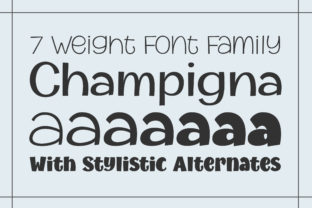
At its core, Champigna Family offers seven weights—from Light to Black—with matching italics across all variants. That means true typographic hierarchy is possible without switching families or compromising rhythm. Its x-height is generous but not overwhelming, supporting strong legibility in both digital interfaces and printed collateral. The letterforms avoid extreme contrast or exaggerated terminals; instead, they rely on consistent stroke modulation and intelligent spacing—traits that translate well across sizes and mediums.
Unlike many contemporary sans serifs that lean heavily into either ultra-minimalism or playful eccentricity, Champigna Family occupies a practical middle ground. It feels current without chasing trends, professional without feeling cold, and distinctive without shouting. That balance makes it especially useful when your goal is to communicate ideas—not just display text.
Creative Applications Across Real Projects
Designers often ask: “Where does this font *live*?” With Champigna Family, the answer spans formats and intentions:
- Brand systems: Use Regular and Medium for body copy and headings respectively, then switch to Bold or Black for logo lockups or hero banners. Its clean structure supports monogramming, wordmarks, and responsive iconography.
- Digital content: On websites and newsletters, pair Champigna Light with Medium for elegant contrast in article intros and pull quotes. Its optimized hinting ensures readability on mobile screens—even at small sizes.
- Educational materials: Teachers and course creators benefit from its friendly neutrality. Try Champigna SemiBold for slide titles and Regular for handouts—students notice clarity before aesthetics.
- Small business marketing: A local café can use Champigna Italic for menu descriptions and Bold for daily specials. The result feels intentional but approachable—no design degree required.
One freelance illustrator recently used Champigna Family across her entire client-facing toolkit: proposal PDFs, Instagram story templates, and even embroidery mockups for client presentations. She chose it not for novelty, but because it held up equally well in print, pixel, and thread—saving hours of reformatting and reinforcing consistency across touchpoints.
Adapting Champigna Family for Different Audiences
A font doesn’t work in isolation—it works in context. How you apply Champigna Family changes based on who’s reading, where they’re reading it, and why.
For entrepreneurs launching a service-based business, start simple: use Champigna Medium for headlines and Regular for website body text. Avoid more than two weights in one layout. This keeps messaging focused and scannable—critical when visitors decide in under eight seconds whether to stay or scroll.
Bloggers and educators can leverage Champigna Italic for emphasis instead of bolding everything. Italics add nuance without visual noise, especially helpful in long-form writing where tone matters as much as information. Pair it with a neutral, highly readable serif for body text if desired—but Champigna Regular stands strongly on its own.
Marketers building email campaigns should test Champigna SemiBold in subject lines and preheaders. Its weight carries presence in crowded inboxes, while remaining compatible with most email clients’ font fallback rules. When embedding web fonts isn’t possible, Champigna’s robust character set (including extended Latin, currency symbols, and diacritics) ensures multilingual messages stay intact.
Staying Clear, Consistent, and Audience-Friendly
Even great tools can be misused. To keep Champigna Family effective—not just attractive—follow three practical guardrails:
- Leverage weight, not size alone. Instead of jumping from 16px Regular to 28px Regular for headings, try 24px Medium. You’ll gain hierarchy, rhythm, and better accessibility—all without sacrificing space.
- Respect line length and spacing. At 100–120 characters per line, Champigna Family reads smoothly. Use generous line-height (1.5–1.6 for body text) and avoid tight letter-spacing unless intentionally styling short labels or logos.
- Test contrast early. Champigna Light looks beautiful on light backgrounds—but may fall below WCAG AA contrast thresholds on white. Check color combinations using free tools like WebAIM’s Contrast Checker before finalizing.
Consistency starts with restraint. Choose no more than three weights for any single project—and stick to them. That discipline helps audiences navigate faster and builds subconscious trust in your communication.
Ideas to Try This Week
You don’t need a full redesign to explore Champigna Family’s potential. Here are low-lift, high-impact experiments:
- Swap your current sans serif heading font for Champigna Bold in one landing page section. Keep body text unchanged. Notice how focus shifts—and where users pause.
- Create a simple social media template: use Champigna SemiBold for captions and Italic for hashtags. Export as PNG and compare engagement metrics over five posts.
- Redesign a single internal document—like a team meeting agenda—with Champigna Regular for items and Medium for time slots. Ask colleagues which version felt easier to scan.
These aren’t about “making things pretty.” They’re about observing how typography influences perception, retention, and action—subtle but measurable shifts that compound over time.
Why Champigna Family Fits Real Creative Work
Good typography serves the idea—not the other way around. Champigna Family reflects that principle. It doesn’t distract, overcompensate, or demand explanation. It simply gives structure to language so people can engage with meaning first.
That’s why it resonates across disciplines: a publisher uses it for clean ebook layouts; a nonprofit applies it to donor reports that must feel trustworthy and human; a product designer selects it for UI labels that need to disappear into the experience—not stand out awkwardly.
If you’ve ever hesitated before choosing a font—wondering whether it’s “too safe” or “not distinctive enough”—consider this: distinction comes from how you use a tool, not just the tool itself. Champigna Family gives you room to think, edit, refine, and connect—without wrestling with inconsistent spacing, weak weights, or unpredictable rendering.
It’s ready when you are.