Laquatsa: A Refreshing Sans Serif for Summery, Human-Centered Design
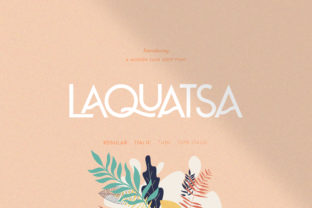
Laquatsa stands out not because it shouts, but because it breathes—light, warm, and effortlessly approachable. It’s a modern sans serif designed with subtle tropical inflections: soft curves, open apertures, and a gentle rhythm that evokes sunshine without leaning into cliché. Unlike many display fonts that sacrifice legibility for flair, Laquatsa balances personality with practicality. It’s not just “cute” or “beachy”—it’s thoughtfully constructed, with consistent stroke contrast, even spacing, and well-proportioned lowercase forms that support sustained reading at medium sizes.
What Makes Laquatsa Distinctive—Beyond the Vibe
At first glance, Laquatsa’s charm is undeniable—but its value becomes clearer on closer inspection. The letterforms avoid exaggerated quirks; instead, they use restrained warmth. Consider the lowercase a and e: both feature rounded, slightly flared terminals—not cartoonish, but friendly. The uppercase S and C have gentle modulation, avoiding the mechanical uniformity of geometric sans serifs. Even the numerals are true tabular figures with balanced weight distribution, making them functional in price tags, event timelines, or data-driven social posts.
Its x-height sits comfortably above average—enhancing readability at smaller sizes—while its ascenders and descenders remain modest, preventing visual clutter in tight layouts. Kerning pairs are carefully tuned, especially in common combinations like “To,” “Go,” and “Let.” That attention shows up most clearly in real use: headlines render cleanly on mobile screens, body text remains legible in email newsletters at 14–16px, and buttons retain clarity even with light background overlays.
Where Laquatsa Performs Best—Real Use Cases
Laquatsa isn’t built for dense legal documents or technical dashboards. Its strength lies in contexts where tone, accessibility, and emotional resonance matter as much as function. Think of a small-batch coffee roaster launching a summer subscription—using Laquatsa for the banner headline (“Let’s Get Tropical”) and supporting subhead (“Fresh beans, sunnier days”) creates cohesion without sacrificing professionalism. Or an educator designing a workshop handout about mindfulness and seasonal rhythms—the font’s calm energy supports the message without distracting from content.
It also works well in digital-first environments where brand voice leans warm and inclusive: landing pages for wellness apps, Instagram carousel text overlays, podcast episode titles, or email subject lines aiming to stand out in a crowded inbox. One freelance illustrator recently used Laquatsa across her portfolio site’s navigation, project titles, and client testimonials—reporting higher engagement on her “About” page, particularly among readers aged 30–45 who commented on its “inviting but not childish” feel.
Practical Flexibility and Technical Reliability
Laquatsa includes standard Latin-1 and extended Latin character sets, covering most Western European languages. It offers regular and bold weights—no italic variant, which is a limitation for long-form editorial use but rarely a barrier for its intended applications. The OpenType features are minimal but effective: discretionary ligatures (like “ff” and “fi”) add polish when enabled, and case-sensitive forms improve all-caps settings without oversizing.
File size is lean—under 40KB for the WOFF2 version—so it loads quickly even on slower connections. It renders consistently across Chrome, Safari, Firefox, and Edge, with no notable hinting issues on Windows or macOS. For developers embedding via Google Fonts or self-hosting, the CSS implementation is straightforward. No unusual fallback requirements: pairing it with system fonts like -apple-system or Segoe UI yields predictable, readable results.
Audience Fit: Who Benefits Most—and When to Pause
Laquatsa serves creators and businesses prioritizing authenticity over trend-chasing. Freelance designers building brand identities for lifestyle brands, educators crafting accessible learning materials, small business owners updating their Shopify storefronts, or bloggers curating seasonal content—all find utility here. Its quiet confidence works especially well for audiences who respond to sincerity: parents seeking mindful products, professionals exploring work-life balance, or community organizers highlighting local events.
That said, it’s not universally appropriate. If your audience expects high-contrast authority (e.g., financial advisors, law firms, enterprise SaaS), Laquatsa’s softness may undercut credibility. Similarly, projects requiring multilingual support beyond Latin scripts—or heavy typographic hierarchy with multiple weights and widths—will likely need supplementation or an alternative. And while its summery feel is intentional, using it year-round demands thoughtful context: a winter holiday campaign might feel tonally off unless deliberately juxtaposed (e.g., “Cozy + Tropical” hybrid branding).
Pairing and Implementation Tips
Laquatsa thrives alongside neutral, highly legible companions. For body text, try Inter, Lato, or Source Sans Pro—fonts with similar x-heights and clean proportions that let Laquatsa shine in headings without clashing. Avoid overly decorative or condensed sans serifs; they compete rather than complement. In print, pair it with uncoated paper stocks to enhance its organic texture—glossy finishes can mute its warmth.
When setting type, respect its natural rhythm: avoid tracking tighter than –10 for headlines under 36px, and steer clear of all-caps usage below 24px. For accessibility, maintain a minimum contrast ratio of 4.5:1 against backgrounds—its regular weight meets this easily on white or light neutrals, but test carefully on pastel or gradient backdrops. And if using “Let’s Get Tropical” as a tagline, consider applying slight letter-spacing (0.5–1px) to improve word separation without breaking flow.
Long-Term Value and Creative Longevity
Fonts come and go, but Laquatsa avoids the trap of being “of the moment.” Its design language nods to mid-century humanist sans serifs—think Frutiger or Syntax—but interprets them through a contemporary lens focused on digital comfort and emotional resonance. That gives it staying power: it won’t look dated in two years because it doesn’t rely on fleeting trends like extreme variable axes or exaggerated ink traps.
Its licensing is straightforward—available under SIL Open Font License for free personal and commercial use, with optional premium versions offering expanded language support and additional weights. That transparency lowers adoption friction for solopreneurs and teams alike. More importantly, Laquatsa invites intentionality: choosing it signals care about how words land, not just what they say. In a landscape saturated with algorithmically generated visuals and AI-written copy, that human-centered emphasis is increasingly rare—and increasingly valuable.
Ultimately, Laquatsa earns its place not by trying to do everything, but by doing one thing exceptionally well: giving warmth structural integrity. Whether you’re drafting a summer newsletter, refining a brand’s visual voice, or simply selecting a font that feels like a deep breath—it’s worth testing, measuring, and trusting where tone matters as much as typography.