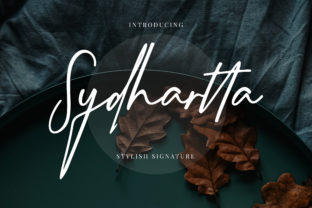
Sydhartta: The Handwritten Font That Brings Warmth Without Compromise
When a design needs to feel human—not polished, not sterile, but genuinely inviting—Sydhartta steps in. It’s not just another script font. It’s a carefully crafted handwritten typeface with a signature-level elegance: fluid strokes, subtle variations in line weight, and an organic rhythm that mimics real pen-on-paper motion. Whether you're designing a wedding invitation, a boutique coffee shop’s menu, or a wellness brand’s landing page, Sydhartta adds warmth without sacrificing clarity or modernity.
What Makes Sydhartta Feel So Naturally Human?
At its core, Sydhartta avoids the trap many “handwritten” fonts fall into: over-stylization. Some scripts lean too hard into calligraphic drama or forced irregularity—making them difficult to read at smaller sizes or awkward in digital interfaces. Sydhartta strikes a rare balance. Its lowercase letters feature gentle entry and exit strokes, slight tapering on ascenders and descenders, and soft, rounded terminals. Uppercase characters carry presence without shouting—each one shaped with intention, not uniformity.
Crucially, Sydhartta includes stylistic alternates and ligatures. These aren’t decorative flourishes added as afterthoughts—they’re integrated thoughtfully. For example, the “fi” and “fl” combinations flow seamlessly, and alternate “a”, “g”, and “y” forms let designers fine-tune tone: playful for a children’s book cover, refined for a luxury skincare label. This level of detail means Sydhartta doesn’t just *look* hand-drawn—it behaves like handwriting does in real life: adaptable, expressive, context-aware.
Where Sydhartta Fits Best (and Where It Surprises)
You’ll often see Sydhartta shine in branding for small businesses rooted in authenticity: artisan bakeries, independent bookstores, yoga studios, ceramic studios, and eco-conscious apparel lines. Its organic texture reinforces values like craftsmanship, care, and connection. But don’t assume it’s limited to “soft” industries.
- Editorial design: Used sparingly for pull quotes or section headers in long-form articles, Sydhartta creates visual breathing room and emotional resonance—especially in lifestyle, travel, or personal essay contexts.
- Digital product interfaces: With careful hierarchy (e.g., pairing Sydhartta for headlines with a clean sans-serif like Inter or Manrope for body text), it adds personality to onboarding flows, empty states, or celebratory microcopy (“You’re all set!”).
- Print collateral: Wedding stationery is a natural fit—but so are limited-run poetry chapbooks, craft fair posters, or even packaging for small-batch kombucha. Its legibility holds up beautifully in offset and letterpress printing.
One unexpected strength? Sydhartta works well in bilingual layouts. Its Latin character set is robust, and the spacing and rhythm translate gracefully when paired with clean, neutral supporting fonts for non-Latin scripts—making it a smart choice for multicultural brands or global creative studios aiming for local warmth without linguistic compromise.
Practical Tips for Using Sydhartta Well
Like any expressive font, Sydhartta rewards thoughtful application—and punishes overuse. Here’s what seasoned designers keep in mind:
- Reserve it for moments that earn attention. Use it for logos, headlines, short quotes, or names—not paragraphs, captions, or data tables. Let it breathe. If your entire website headline is in Sydhartta at 48px, the impact flattens. But if it appears once on the homepage hero, above a clean image and ample whitespace? Instant recognition and feeling.
- Pair it with purpose—not just contrast. Avoid defaulting to “script + sans-serif” without intention. Try Sydhartta with a warm, slightly rounded sans (like Quicksand) for approachability—or a crisp, low-contrast serif (like Playfair Display) for elevated contrast. The goal isn’t just readability—it’s tonal harmony.
- Test it across devices and weights. Sydhartta performs best at medium to large sizes (24px and up for web, 14pt+ for print). On mobile, avoid using it for navigation labels or buttons. Also, check how its light and regular weights render on older Android devices or Windows browsers—some hinting may shift subtly. When in doubt, export key headlines as SVG or use variable font fallbacks if available.
- Think beyond static use. Because Sydhartta feels so alive, it lends itself beautifully to subtle animation: a slow fade-in with a slight staggered letter delay, or a gentle “inking” effect on hover. These micro-interactions deepen engagement without distracting—especially effective on portfolio sites or creative agency landing pages.
Why Designers Choose Sydhartta Over Other Handwritten Fonts
There’s no shortage of handwritten fonts today—many free, many trendy. So why do professional designers consistently return to Sydhartta? Three reasons stand out:
- Consistency with character. Unlike fonts that alternate wildly between ultra-thin and bold strokes in unpredictable ways, Sydhartta maintains a cohesive voice. Its weight distribution feels intentional, not arbitrary—so your logo and Instagram story template feel like parts of the same visual language.
- Cross-platform reliability. It’s well-hinted, includes full OpenType features (small caps, fractions, ordinals), and renders cleanly in Figma, Adobe apps, and modern CSS environments. No last-minute “why does this ‘t’ look clipped?” panic before client delivery.
- Emotional precision. Want friendly but not childish? Elegant but not formal? Artisanal but not rustic? Sydhartta lands precisely in that middle ground. It conveys sincerity without pretense—making it ideal for brands building trust through authenticity, not aesthetics alone.
Real-World Scenarios: How Sydhartta Solves Design Challenges
Consider a local florist launching a new seasonal subscription service. Their existing branding felt generic—stock photos, basic sans-serif typography, no distinct voice. By introducing Sydhartta for the service name (“Spring Bloom Box”) and handwritten-style taglines (“Hand-tied. Home-grown. Heart-led.”), they instantly communicated care and curation. The font’s gentle curves echoed the shape of petals; its uneven baseline suggested hand-picked freshness—not mass production.
Or take a mindfulness app redesign. Early versions used minimalist geometric fonts that felt calm but emotionally distant. Switching to Sydhartta for onboarding prompts (“Breathe in. Notice how your shoulders soften.”) created immediate intimacy. Users reported feeling “guided,” not instructed—a subtle but critical shift in perceived tone.
Even in corporate contexts, Sydhartta finds quiet power. A sustainable architecture firm used it only on their “Our Process” page header—paired with documentary-style photography and technical diagrams. The contrast didn’t clash; it humanized complexity. Visitors didn’t just understand the methodology—they sensed the people behind it.
Final Thought: It’s Not Just About Looks—It’s About Feeling Seen
In a world saturated with algorithm-driven feeds, AI-generated copy, and templated UIs, Sydhartta offers something quietly radical: evidence of the human hand. Not as nostalgia, but as intention. It reminds viewers—and creators—that clarity and warmth aren’t opposites. That professionalism doesn’t require sterility. That a signature touch, applied with care, can make the difference between being noticed… and being remembered.
If your next project asks for authenticity—not as a buzzword, but as a lived experience—Sydhartta isn’t just a font choice. It’s a first sentence in a conversation you want to keep having.