Aprilea Script: A Handwritten Font with Authentic Charm
Aprilea Script stands out in the landscape of handwritten display fonts—not because it’s the most technically precise or the most widely licensed, but because it balances playfulness and authenticity in a way that feels intentional, not accidental. It’s designed to evoke the warmth of pen-on-paper without sacrificing legibility or versatility. Unlike many script fonts that lean heavily into either ultra-thin elegance or bold, bouncy exuberance, Aprilea Script occupies a middle ground: relaxed but controlled, casual but considered.
What Makes Aprilea Script Distinct?
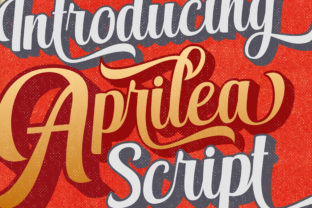
At its core, Aprilea Script is a single-weight, connected script font with subtle variation in stroke thickness—enough to suggest natural hand movement, but not so much that letters become hard to distinguish at smaller sizes. Its lowercase ‘g’, ‘y’, and ‘f’ feature gentle, open descenders; its capitals have soft entry and exit strokes rather than sharp terminals. These details avoid the “too-perfect” look common in digitized scripts, giving Aprilea Script an organic rhythm when set in longer phrases.
It’s also intentionally limited in stylistic alternates. There are no swash capitals, no contextual ligatures, and no decorative flourishes built into the font file. That restraint isn’t a shortcoming—it’s a design choice that supports clarity and consistency across applications. Where some handwritten fonts rely on OpenType features to feel “alive,” Aprilea Script achieves character through spacing, proportion, and subtle imperfection.
Fitting Into Real-World Design Workflows
Because Aprilea Script is a single-style, non-variable font, it works best when paired deliberately—not as a standalone typographic system, but as part of a thoughtful hierarchy. For example, it pairs naturally with clean, neutral sans serifs like Inter, Lato, or even Helvetica Neue. In branding for small creative businesses—think independent bakeries, ceramic studios, or boutique wellness services—Aprilea Script often serves as a primary logo mark or headline treatment, while body text remains highly legible and functional.
Its organic nature makes it especially effective in contexts where digital polish can feel distancing: handmade product labels, invitation suites, Instagram story overlays, or printed zines. One designer recently used Aprilea Script for a seasonal menu at a neighborhood café—hand-lettered headers were recreated digitally using the font, then layered over photos of chalkboard textures. The result felt cohesive and human-scaled, not templated.
Where Aprilea Script Excels—and Where It Doesn’t
Aprilea Script shines in short-form, high-impact uses: logos, social media graphics, packaging accents, greeting cards, and editorial pull quotes. Its rhythm and warmth help convey approachability and craft—qualities that resonate strongly with audiences seeking authenticity over gloss.
It’s less suited for extended body copy, UI interfaces, or environments demanding strict accessibility compliance. Like most script fonts, Aprilea Script has low x-height and tight letterfitting, which reduces readability below ~24pt in print or ~18px on screen. It also lacks language support beyond basic Latin (no Cyrillic, Greek, or extended diacritics), limiting use in multilingual projects.
Another practical consideration: Aprilea Script is typically offered as a desktop font license—not web-optimized by default. While it can be converted for web use via services like Cloud.typography or self-hosted @font-face, performance and rendering consistency vary across browsers and operating systems. Designers weighing long-term maintainability may prefer web-native alternatives if responsive typography is central to the project.
Comparing Approaches: When to Choose Aprilea Script Over Other Options
Handwritten fonts fall into several broad categories: calligraphic (with strong contrast and formal structure), brush-based (loose, textured, often irregular), and casual script (friendly, flowing, everyday-feeling). Aprilea Script sits firmly in the last group—but with more discipline than many peers.
Compared to highly variable brush fonts—those with dramatic texture shifts or heavy ink bleed—Aprilea Script offers greater control and predictability. A wedding stationery designer might choose a brush font for an invitation’s “RSVP” line to emphasize artistry, but switch to Aprilea Script for the couple’s names to ensure legibility and balance. The distinction isn’t about quality; it’s about function and audience expectation.
Within the casual script category, Aprilea Script avoids two common pitfalls: excessive bounce (which can feel juvenile in professional contexts) and monotonous uniformity (which drains energy from the type). Its baseline subtly undulates, and spacing gently breathes—details that register intuitively rather than analytically. That makes it more adaptable than fonts with rigid vertical metrics or exaggerated ascenders/descenders.
Practical Tradeoffs to Weigh
- Licensing simplicity: Aprilea Script is usually available under straightforward desktop or extended licenses—no tiered subscriptions or usage caps. That’s helpful for freelancers managing multiple clients or small studios building brand guidelines.
- File size & compatibility: As a standard OTF/TTF, it installs easily and renders reliably in Adobe apps, Figma (via plugins), and mainstream design tools. No special rendering engines or fallbacks required.
- Customization limits: Because it lacks stylistic sets or weight variants, customizing tone—say, making it feel slightly more formal or more playful—requires manual adjustments: tracking, baseline shift, or pairing with contrasting elements. That’s manageable for experienced designers but may add time for beginners.
- Scalability: It holds up well from 20pt to 120pt, but loses nuance below 16pt. For responsive web layouts where headlines shrink on mobile, consider whether the intended impact survives at reduced size—or whether a secondary, simpler typeface should take over at breakpoints.
Who Benefits Most From Aprilea Script?
Aprilea Script suits designers and creators who value intentionality over ornamentation—those who understand that authenticity isn’t just about appearance, but about alignment between voice, medium, and audience. It’s frequently chosen by:
- Branding designers developing visual identities for lifestyle, wellness, food, or artisanal brands;
- Print designers crafting packaging, stationery, or limited-run publications;
- Small business owners creating their own marketing assets with tools like Canva or Adobe Express (where Aprilea Script is often pre-installed or easy to upload);
- Educators and workshop facilitators designing handouts or presentation slides that prioritize warmth and engagement over corporate neutrality.
It’s less ideal for enterprise branding systems requiring extensive language support, strict WCAG compliance, or scalable typographic architecture across dozens of touchpoints. In those cases, a hybrid approach—using Aprilea Script for expressive moments while relying on a robust sans serif for functional text—often yields better long-term results.
Making a Grounded Choice
Selecting a handwritten font isn’t just about liking how it looks—it’s about evaluating how it behaves across contexts, how it supports your message, and how it fits within technical and strategic constraints. Aprilea Script doesn’t try to do everything. Instead, it does one thing very well: lend a genuine, unhurried, hand-drawn sensibility to designs that benefit from humanity—not perfection.
If your goal is to soften a layout without sacrificing clarity, to signal care in execution without leaning into nostalgia or whimsy, or to unify a brand’s voice across tactile and digital formats with consistent warmth—then Aprilea Script deserves serious consideration. But if you need multilingual support, fine-grained optical sizing, or seamless web integration out of the box, it’s worth exploring complementary options alongside it.
Ultimately, the right font isn’t the one with the most features—it’s the one that disappears just enough to let the content breathe, while still carrying quiet intention in every curve.