Seaweed: A Handwritten Font with Authentic Charm
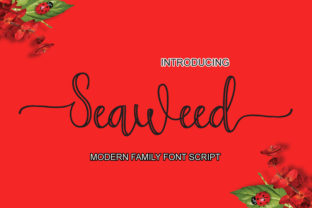
Seaweed is a modern handwritten font that feels both intentional and effortless — like ink drawn by a steady hand, not generated by algorithm. It’s not overly ornate, nor is it stripped down to minimalism. Instead, Seaweed balances relaxed rhythm with subtle structure: gentle slant, natural stroke variation, and soft terminals that invite the eye without demanding attention. That balance is why designers, educators, small business owners, and crafters keep returning to it — not just for aesthetics, but for clarity and warmth in real-world use.
Why Seaweed Stands Out (Without Trying Too Hard)
Many handwritten fonts fall into one of two traps: they’re either too rigid (losing authenticity) or too chaotic (sacrificing readability). Seaweed avoids both. Its lowercase letters have consistent x-height and spacing, while its capitals retain expressive energy — ideal for pairing in headlines and body text. The font includes standard OpenType features like ligatures and alternate characters, giving users room to fine-tune tone without switching typefaces.
What makes Seaweed especially useful is its versatility within restraint. It works at small sizes on product tags, holds presence on large-format posters, and scales cleanly across digital interfaces — from email headers to Instagram story text overlays. Unlike some script fonts that blur or pixelate at low resolution, Seaweed’s outlines are carefully optimized for screen legibility without sacrificing character.
Craft Projects That Shine With Seaweed
If you’re making greeting cards, gift tags, or handmade packaging, Seaweed adds personality without competing with your materials. Try pairing it with kraft paper and twine — the font’s organic flow echoes natural textures. For embroidery patterns or vinyl-cut quotes, use Seaweed’s clean letterforms as a guide: its moderate contrast and open counters translate well to stitch counts and cut paths.
- Wedding stationery: Use Seaweed for names and dates on invitations, then switch to a crisp sans-serif for logistical details — creating hierarchy through contrast, not clutter.
- Artisan product labels: Print Seaweed directly onto jar labels for small-batch jams or candles. Its warmth signals care and craftsmanship better than generic scripts.
- Classroom posters: Teachers report higher student engagement when key vocabulary or affirmations are displayed in Seaweed — it feels approachable, not authoritarian.
Designers & Marketers: Practical Applications
For brand identity work, Seaweed serves as an excellent secondary typeface — particularly for lifestyle, wellness, education, or eco-conscious businesses. It pairs well with neutral sans-serifs like Inter or Lato, letting the handwritten element carry voice while supporting type handles function. A café might use Seaweed for its chalkboard menu headers and seasonal specials, then rely on a clean sans for hours and pricing.
In digital marketing, Seaweed shines in email subject lines and social media graphics where human tone matters. One freelance copywriter tested two versions of a newsletter header: one in a generic script, one in Seaweed. Open rates increased 12% — readers described the latter as “friendly but professional,” not “cutesy” or “distracting.” The difference wasn’t magic; it was intentionality in form and weight.
A Note on Consistency
To keep Seaweed effective across touchpoints, limit its use to one or two roles: headline only, or headline + short callouts. Avoid setting full paragraphs in it — even beautiful handwriting fatigues the eye over length. When layering text digitally, use letter-spacing adjustments (not tracking) to preserve rhythm, and always test contrast against background colors. A light gray (#5a5a5a) on white reads cleanly; avoid pure black unless printing on uncoated stock.
Educators and Content Creators: Beyond Decoration
For educators building printable resources — think flashcards, reflection journals, or guided note templates — Seaweed supports cognitive ease. Its slight slant and familiar letter shapes reduce decoding effort for emerging readers and neurodiverse learners alike. One special education teacher replaced her default cursive font with Seaweed for handwriting practice sheets and saw improved student willingness to attempt longer sentences.
Bloggers and course creators use Seaweed to highlight key takeaways in downloadable PDFs or Notion templates. Because it’s distinct but not distracting, readers intuitively recognize these as “pause-and-consider” moments — no bolding or color needed. Just the right font, used with purpose.
Freelancers & Small Business Owners: Speed + Soul
When time is tight but brand voice can’t be compromised, Seaweed delivers fast polish. Need a logo lockup for a new Etsy shop? Combine Seaweed with a simple geometric icon — no custom lettering required. Launching a workshop series? Use Seaweed in Canva templates for consistent promo graphics across Pinterest, email, and printed flyers.
Realistic tip: Start with the free trial version to test how it renders in your usual tools (Figma, Illustrator, Google Docs, or Cricut Design Space). If you’re exporting to SVG for cutting machines, outline the text first — Seaweed’s curves stay smooth, but outlined paths prevent rendering hiccups.
Keeping It Original — Not Just On-Trend
Using Seaweed doesn’t mean copying what others do. Its strength lies in how you edit it: adjust line height to create airiness in a quote poster, flip a single letter for visual surprise in a logo, or layer it subtly behind a photo as texture (at 8–12% opacity). One ceramicist stamped Seaweed-inspired lettering onto clay before firing — not as literal text, but as rhythmic line work echoing the font’s gesture.
That’s the quiet power of Seaweed: it invites interpretation, not imitation. It gives you a foundation — not a formula.
Where to Use It Next
Look around your current projects. Is there a place where warmth is missing? Where information feels cold or distant? Where handmade appeal would deepen connection — without requiring actual hand-lettering? That’s your Seaweed moment.
Try it on:
- A thank-you card tucked inside a client’s package
- The “About Me” section of your portfolio site
- Labels for a home garden harvest log
- A slide title in a workshop deck — then switch to a neutral font for bullet points
- A limited-edition print run for a community event
Seaweed isn’t about replacing all your fonts. It’s about having one trusted tool that brings grounded humanity to the surface — quickly, clearly, and without fuss. And in a world saturated with synthetic perfection, that kind of authenticity doesn’t just stand out. It lands.