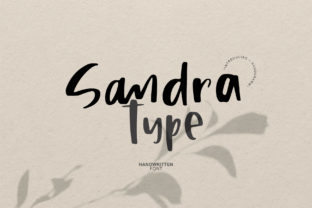
Sandra Type: Where Lightness Meets Authenticity in Modern Typography
There’s a quiet shift happening in how we choose type—not just for logos or websites, but for emails, social posts, pitch decks, classroom handouts, and even product packaging. It’s not about chasing novelty. It’s about resonance. And Sandra Type, a light and charming handwritten font, lands precisely where that resonance lives: in warmth, approachability, and unforced sincerity.
Sandra Type isn’t built for dominance. It doesn’t shout. Instead, it leans in—slightly irregular, gently tapered, with soft curves and open counters that breathe on the page. Its lowercase a has a subtle tilt; its g carries a looping tail that feels like a pause mid-thought. These aren’t flaws. They’re signatures of human rhythm—evidence of ink meeting paper, not algorithm meeting grid. That authenticity isn’t decorative. It’s functional. In an era where attention is fragmented and trust is earned incrementally, type that feels *made by hand* subtly signals care, intention, and presence.
Why Handwritten Fonts Like Sandra Type Are Gaining Ground—Without the Gimmick
Handwritten fonts used to be relegated to birthday invitations or craft blogs. Today, they appear in investor pitch decks from Brooklyn startups, on minimalist skincare labels in Tokyo boutiques, and in the slide headers of university faculty sharing research with community stakeholders. What changed isn’t the font—it’s the context.
We’re no longer optimizing solely for speed or scalability. We’re optimizing for connection. Remote work normalized asynchronous communication, but it also heightened our sensitivity to tone. A sterile sans-serif in a client email can read as efficient—or distant. Sandra Type, applied thoughtfully, adds a layer of grounded humanity without sacrificing clarity. It works because it’s restrained: light in weight, moderate in contrast, legible at small sizes, and harmonious alongside clean supporting typefaces like Inter or Lora.
This isn’t nostalgia for analog. It’s responsiveness to real behavior. People scroll faster—but they linger longer on content that feels personally addressed. A newsletter header set in Sandra Type invites slower reading. A workshop handout using it feels less like a directive and more like an invitation. That nuance matters—for educators building inclusive classrooms, for freelancers differentiating their brand voice, for small business owners who want their website to reflect the care they put into their products.
How Sandra Type Fits Into Evolving Creative Workflows
Design tools have democratized typography—but not always wisdom. Drag-and-drop builders, Canva templates, and AI-generated mockups make it easy to apply “handwritten” styles indiscriminately. The result? Visual noise. Sandra Type stands out because it resists that impulse. Its charm lies in its discipline: it’s handwritten, yes—but with consistency, rhythm, and spacing that support readability, not undermine it.
That makes it unusually practical for modern workflows. Unlike many script fonts that require manual kerning or ligature toggling, Sandra Type is engineered for real use: OpenType features include contextual alternates that soften repetition (so consecutive “a”s don’t look identical), and its metrics align cleanly with web-safe fallbacks. Designers embed it via variable font files; developers serve it efficiently through modern CDNs; marketers drop it into email clients with predictable rendering.
Consider a freelance copywriter crafting a lead magnet. Instead of defaulting to Montserrat for every heading, they use Sandra Type for the title (“Your First 30-Minute Brand Clarity Session”) and pair it with a neutral serif for body text. The effect isn’t “cute”—it’s confident and human-centered. Or picture a yoga studio owner updating their Instagram bio. A single line set in Sandra Type—“Breathe here. Belong here.”—carries more emotional weight than five lines of standard type. It doesn’t explain the practice; it embodies its tone.
Practical Implications: Where and How Sandra Type Adds Value
Using Sandra Type well isn’t about applying it everywhere. It’s about strategic emphasis—where authenticity needs to land most clearly. Here’s where it consistently delivers:
- Brand voice anchors: Logos are rare (its lightness doesn’t scale to signage), but it excels in submarks, signature lines, or taglines—especially for service-based businesses, wellness practitioners, educators, and creative studios.
- Digital-first touchpoints: Email headers, landing page testimonials, newsletter sign-up prompts, and micro-interactions (like “Thanks!” after form submission) benefit from its gentle authority.
- Print with purpose: Letterpress business cards, workshop worksheets, recipe cards, or limited-run zines gain tactile credibility when Sandra Type appears alongside thoughtful paper stock and ink choices.
- Educational materials: Teachers use it for classroom posters or student-facing instructions—not for dense paragraphs, but for framing questions, highlighting core values, or naming collaborative norms (“Listen deeply. Share bravely.”).
Crucially, Sandra Type doesn’t require design expertise to use well. Its light weight means it won’t overwhelm layouts. Its generous x-height ensures legibility on mobile screens. And because it avoids extreme flourishes, it pairs naturally with both geometric sans-serifs (for contrast) and warm serifs (for harmony). The key is restraint: one weight, one size range (18–36px for digital display), and intentional whitespace around it.
Looking Ahead: Not a Trend, But a Tendency
Typography doesn’t trend the way fashion does. It evolves in response to cultural conditions—and right now, those conditions favor honesty over polish, clarity over cleverness, and warmth over neutrality. Sandra Type reflects that tendency. It’s not replacing system fonts. It’s complementing them—filling the space between corporate uniformity and chaotic DIY energy.
That balance is why it resonates across professions. A marketer might use it to soften a data-heavy report’s executive summary. A therapist could apply it to session reflection prompts shared with clients. A software developer documenting an open-source tool might choose it for the “Welcome” section of their README—signaling that behind the code is a person who cares about how others experience it.
What’s emerging isn’t a demand for “more handwritten fonts.” It’s a deeper expectation: that digital interfaces, brand expressions, and everyday communications should feel *attentive*. Not perfect. Not automated. Attentive. Sandra Type supports that quietly—through its slight imperfections, its gentle stroke modulation, its refusal to erase the hand behind the mark.
A Realistic Recommendation for Getting Started
If you’re curious, start small—and intentionally. Don’t retrofit your entire website. Instead:
- Pick one recurring element where tone matters most: your email newsletter subject line, your portfolio project tagline, or the “thank you” message after a contact form submission.
- Set it in Sandra Type at 24–28px, with generous line height (1.5–1.7) and ample margin.
- Pair it with a highly legible, neutral companion font—something like Source Serif Pro or IBM Plex Sans—for all other text.
- Test it across devices. Does it remain clear on a phone screen? Does it load quickly? Does it feel like a natural extension of your voice—not a costume?
You’ll know it’s working when people don’t comment on the font itself—but do notice the feeling it creates: calm, considered, and quietly confident. That’s the point. Sandra Type doesn’t ask to be admired. It asks to be trusted. And in today’s landscape, that’s the most valuable kind of typography there is.