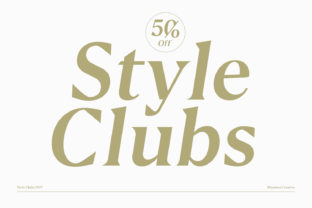
Style Clubs: A Strategic Serif for Intentional Design
Style Clubs is more than a font—it’s a deliberate design decision. As a modern and smart serif typeface with a simple, uncluttered feel, it bridges tradition and clarity without leaning into nostalgia or austerity. Its balanced letterforms, generous x-height, and restrained contrast make it highly legible at small sizes and expressive at display scale. For professionals who rely on visual communication to convey credibility, refinement, and quiet confidence—entrepreneurs launching a boutique brand, educators designing course materials, marketers crafting email campaigns, or publishers laying out long-form editorial content—Style Clubs offers a consistent tonal anchor.
Why Choose Style Clubs Over Other Serifs?
Not all serifs serve the same strategic purpose. Some evoke heritage (think Times New Roman), others signal luxury (Didot), and many prioritize ornamentation over function. Style Clubs avoids those extremes. It doesn’t shout; it listens. That makes it especially useful when your goal is to support—not overshadow—your message. In branding, for example, a clean serif like Style Clubs helps position a service-based business as both approachable and authoritative. It signals competence without coldness, simplicity without minimalism-for-its-own-sake.
This matters in practice: a financial advisor using Style Clubs in client reports communicates precision and care, not bureaucracy. A wellness coach selecting it for digital workbooks conveys groundedness and intention—not clinical detachment. The difference lies in how the typeface shapes perception before a single word is read.
Where Style Clubs Delivers Measurable Value
Strategic typography isn’t about aesthetics alone—it’s about reducing friction and reinforcing intent. Here’s where Style Clubs consistently supports outcomes:
- Brand consistency across touchpoints: Because it works equally well in print (business cards, brochures), web (body text, headings), and digital interfaces (dashboards, PDFs), Style Clubs reduces the need to juggle multiple type families—lowering design debt and improving implementation speed.
- Readability in long-form contexts: Its open counters and even rhythm improve comprehension in newsletters, whitepapers, and educational modules—especially for readers scanning on mobile or reading extended passages.
- Positioning clarity for premium offerings: Unlike overly decorative serifs, Style Clubs implies craftsmanship without pretension. It’s a strong fit for subscription services, coaching programs, or artisanal products where trust and clarity are prerequisites to conversion.
- Efficient design iteration: With a full set of weights (Light to Bold) and true italics, designers can establish clear typographic hierarchy without switching fonts—saving time during layout revisions and stakeholder feedback cycles.
Practical Use Cases—Beyond “Just Another Font”
Consider how Style Clubs operates in real workflows:
- A freelance copywriter uses Style Clubs Light for body copy in pitch decks—creating visual breathing room that invites clients to focus on strategy, not style.
- A small publisher selects Style Clubs Regular for ebook interiors, then pairs it with a subtle sans-serif for captions—achieving distinction without dissonance.
- An edtech startup applies Style Clubs SemiBold for section headers in its learning platform, ensuring scannability while maintaining academic gravitas.
- A local bakery prints packaging labels in Style Clubs Bold—it reads clearly on matte kraft paper and subtly elevates perceived value without appearing corporate.
Notice what’s consistent: Style Clubs isn’t used to “make things look nice.” It’s used to reduce ambiguity, align tone with audience expectations, and remove visual noise that competes with meaning.
What to Consider Before Committing
Like any tool, Style Clubs requires context to deliver value. Using it without alignment to goals can backfire. For instance:
- It’s not ideal for high-energy, youth-oriented brands seeking bold personality or irreverence. Its calm demeanor may read as distant or overly formal in contexts demanding immediacy or playfulness.
- Pairing matters deeply. Avoid pairing Style Clubs with ultra-thin, geometric sans-serifs (e.g., Montserrat Thin) unless you’re intentionally creating tension. Better pairings include warm, humanist sans-serifs like Inter, Lato, or Nunito—fonts that share its emphasis on readability and proportion.
- Licensing and technical constraints apply. Confirm usage rights for web embedding, app integration, or commercial redistribution—especially if distributing branded templates or SaaS tools. Self-hosted web fonts require proper
@font-facedeclarations and fallback strategies.
Also consider your audience’s environment. If most of your readers engage via older Android devices or legacy email clients, test rendering carefully—some serif fonts degrade in low-resolution rendering. Style Clubs holds up well, but verification remains essential.
How to Use Style Clubs Intentionally—Not Automatically
Intentionality starts with asking three questions before applying Style Clubs:
- What outcome do I want this piece to drive? (e.g., “I want readers to trust this pricing page enough to book a call.”)
- What feeling should accompany that action? (e.g., “Confidence, not excitement; clarity, not urgency.”)
- Does Style Clubs reinforce—or dilute—that feeling in this specific context?
If the answer to #3 is “reinforce,” proceed. If it’s unclear, pause and compare alternatives—not just visually, but by testing with actual users. One marketer found Style Clubs increased time-on-page by 18% on her resource library landing page, but decreased click-throughs on a limited-time promo banner. The insight? Style Clubs supported deep engagement, not impulse. She switched the banner to a friendly sans-serif—and conversions rose.
This kind of observation separates tactical use from strategic use. Style Clubs earns its place when it serves a documented objective—not because it’s “trendy” or “elegant” in the abstract.
Long-Term Positioning and Evolution
Typography choices compound over time. A brand built around Style Clubs gains coherence as it scales—across social graphics, sales decks, customer support emails, and product documentation. That cohesion builds recognition faster than inconsistent styling ever could. But evolution matters too. As your audience grows or your offering matures, revisit whether Style Clubs still reflects your current positioning. A law firm might start with Style Clubs for its traditional yet forward-looking tone—but shift toward a slightly more robust serif (or add a secondary display font) once it expands into public advocacy work requiring greater visual authority.
The key is treating Style Clubs not as a one-time selection, but as part of an evolving typographic system—one that adapts alongside your goals, audience needs, and operational realities.
Final Thought: Typography as Quiet Leverage
In a world saturated with visual noise, restraint is rare—and powerful. Style Clubs leverages that power. It doesn’t demand attention; it earns it through consistency, clarity, and craft. When chosen deliberately—and paired with sound strategy—it becomes invisible in the best way: supporting understanding, building trust, and helping your work land with the weight it deserves. That’s not decoration. That’s leverage.