Yoshimura: A Handwritten Font with Strategic Authenticity
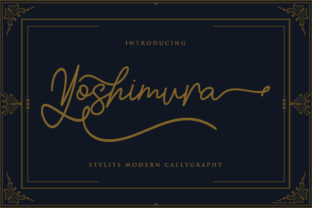
Yoshimura isn’t just another decorative script—it’s a deliberate design choice rooted in human gesture, rhythm, and intention. As a stunning handwritten font, Yoshimura carries the warmth of ink on paper, the slight irregularities of real pen movement, and the quiet confidence of practiced craftsmanship. Its authenticity isn’t performative; it’s structural. That distinction matters—especially when your goal is clarity, connection, or credibility—not just visual flair.
Why Yoshimura Fits Purposeful Communication
Most brands and creators default to clean, geometric fonts for safety. But safety rarely builds resonance. Yoshimura stands out precisely because it resists automation: its subtle variations in stroke weight, baseline tilt, and letter spacing reflect human presence. That makes it uniquely suited for contexts where trust, personality, or narrative weight matter more than neutrality.
Consider this: a small business owner launching a ceramic studio doesn’t need sterile typography—they need texture that mirrors their process. A freelance educator designing a workshop syllabus benefits from Yoshimura’s approachability, signaling care without sacrificing professionalism. A publisher releasing a memoir or essay collection might use Yoshimura for chapter titles—not as decoration, but as tonal framing. In each case, the decision isn’t about “looking nice.” It’s about aligning visual language with lived experience.
When Yoshimura Adds Value—and When It Doesn’t
Strategic use starts with asking: What outcome do I want this text to support? Yoshimura excels in moments of emphasis, invitation, or intimacy—but falters in dense information, technical documentation, or accessibility-critical interfaces.
- Use Yoshimura for: Logo lockups (when brand voice is warm and artisanal), book covers, event invitations, signature lines in email footers, limited-edition packaging, hand-drawn-style illustrations paired with text, and short-form social media graphics where tone > speed of reading.
- Avoid Yoshimura for: Body copy longer than two lines, legal disclaimers, data tables, mobile app navigation labels, multilingual interfaces with complex scripts, or any context requiring WCAG AA contrast or screen reader reliability without careful fallback planning.
This isn’t limitation—it’s precision. Just as you wouldn’t choose a sledgehammer to hang a framed photo, Yoshimura isn’t meant for every typographic job. Its power lies in restraint.
Planning Your Use of Yoshimura
Before applying Yoshimura, map it to your goals—not your aesthetics alone. Ask yourself three questions:
- Is this text meant to be read—or felt first? If emotional resonance precedes comprehension (e.g., a tagline, a greeting card, an artist statement), Yoshimura may deepen impact.
- Who needs to access this—and how? If your audience includes people with low vision, dyslexia, or non-native readers, pair Yoshimura with a highly legible sans-serif for body text and ensure sufficient contrast (at least 4.5:1 against background).
- Does this reinforce consistency—or dilute it? Using Yoshimura across five unrelated platforms without supporting design logic (color, spacing, hierarchy) weakens rather than strengthens recognition. One strong application beats five scattered ones.
Real-world example: A nutritionist redesigned her client onboarding PDF using Yoshimura only for section headers (“Your First Steps,” “What to Expect”) while keeping body text in a clear, open-sans variant. Clients reported the document feeling “more personal and less clinical”—without sacrificing readability. The font didn’t carry the message; it framed it.
Risks of Using Yoshimura Without Strategy
Authenticity can’t be borrowed—it must be earned through alignment. Misusing Yoshimura risks unintended signals: amateurism, inconsistency, or even exclusion. A tech startup using Yoshimura for its API documentation confuses developers who expect clarity and predictability. A university admissions office applying it to financial aid forms may unintentionally signal informality where rigor and transparency are expected.
More subtly, overuse erodes impact. When every headline, button, and testimonial quote uses Yoshimura, it stops feeling intentional and starts feeling habitual—or worse, decorative. That undermines the very authenticity it promises.
The deeper risk isn’t aesthetic—it’s strategic drift. Choosing Yoshimura because “it’s trending” or “my designer suggested it” sidesteps the core question: What does this choice help me achieve that alternatives don’t? Without that grounding, typography becomes noise—not navigation.
How to Use Yoshimura Intentionally
Intentional use begins with editing—not embellishing. Start with plain text. Then ask: Where does this text need to breathe, pause, or invite attention? Apply Yoshimura only there.
Practical tactics:
- Leverage hierarchy deliberately. Use Yoshimura at one size and weight—never multiple variants—paired with a single complementary typeface. This avoids visual competition and keeps focus on meaning.
- Test legibility early. Print a sample at actual size. View it on a phone screen at 75% zoom. Read it aloud. If hesitation occurs beyond the first few words, reconsider placement or scale.
- Anchor it in behavior—not just visuals. If you’re using Yoshimura in a newsletter subject line, ensure the email content delivers on the warmth or individuality the font implies. Mismatched tone creates cognitive dissonance, not connection.
- Document your rationale. Note why Yoshimura was chosen for a specific use case—for your team, your developer, or your future self. This builds continuity and prevents reactive changes later.
One freelance writer uses Yoshimura exclusively for her email signature—now a recognizable marker across hundreds of client communications. It doesn’t appear elsewhere on her site or proposals. That singular, consistent use has made it synonymous with her voice—not her branding, but her presence.
Long-Term Value Beyond Aesthetics
Typography shapes perception over time. Yoshimura, used well, contributes to what psychologists call “perceived expertise”: the impression that someone understands both craft and context. That matters when positioning services, launching products, or building authority in competitive fields.
But long-term value also means adaptability. Yoshimura works today because it avoids digital sterility—but it will remain relevant only if used in ways that evolve with your goals. A bakery using Yoshimura for its 2022 holiday menu should reassess in 2025: Has their audience grown? Has their product line expanded into wholesale? Does the font still reflect their operational maturity—or does it now feel like nostalgia?
That kind of reflection isn’t about chasing trends. It’s about stewardship—of your message, your audience’s attention, and your own creative integrity.
Final Thought: Authenticity Is a Practice, Not a Style
Yoshimura feels authentic because it mirrors how people actually write—not because it’s inherently “real.” Its value emerges only when matched with real decisions: What do you want someone to understand? How much time do they have? What action do you hope follows? Answer those first—and Yoshimura becomes a tool, not a trope.
So don’t ask, “Does this look good?” Ask, “Does this serve what matters most right now?” That shift—from ornamentation to intention—is where Yoshimura earns its place.